Pages

Tuesday, 1 March 2016

Canada and U.S. both won the War of 1812

According to a new perspective at citizenship guides, and trying to decipher who actually won the War of 1812, a new guide says both.

It is an interesting outlook.


Written by TRISTIN HOPPER The National Post

There is a lot of overlap between the guides the U. S. and Canada give new citizens; both tell newcomers the countries are built on native land, people can choose any religion they want and nobody is “above the law.”


But in one glaring difference, they both proudly claim they were victorious in the War of 1812.

“The Americans won the war,” declares a 34-page civics guide issued to prospective citizens by the U.S. Department of Homeland Security.

The Canadian guide notes the pre-Confederation British colonies “defeated an American invasion.”

“Believing it would be easy to conquer Canada, the United States launched an invasion in June 1812,” reads Page 17 of Discover Canada.

“The Americans were mistaken.”

On the weekend, Immigration Minister John McCallum hinted the Canadian citizenship guide’s retelling of the War of 1812 would be pared down.

“If you ask an average Canadian what Canada means, maybe they’ll say hockey, maybe they’ll say something else, they’re not likely to say the War of 1812,” he told CBC’s The House on Saturday.

Saying that the guide was threaded through by an “ideological element,” McCallum added, “I’m not antimilitary, but I do think it was a little heavy on the military.”

Altogether, military matters take up about 1,500 words of the guide’s 40,000 words.

American proclamations they triumphed in the War of 1812 is nothing new — they have long fuelled the myth that, before Vietnam, the United States had never lost a war.

Alan Taylor, a Pulitzer Prize-winning historian at the University of Virginia, says both countries are right.

While the Canadian provinces successfully repelled a much larger U.S. invasion force, the United States arguably held its own in the wider conflict, which included naval battles and British actions against the American South.

“The war is much more than just the American invasion of Canada,” said Taylor.

Still, it’s a rare victory where a country gets much of its capital burned down and enters peace negotiations with enemy troops on its soil — as the United States did in 1814.

“The great majority of American academic historians would say it’s a war that went very badly for the United States and they were lucky to get such a favourable peace treaty,” said Taylor, who wrote a 2010 book on the conflict.

Eliot Cohen, a Johns Hopkins University professor, goes even further. In a 2011 book he wrote that “ultimately, Canada and Canadians won the War of 1812.”

McCallum not only took issue with mentions of Canadian military might in the citizenship guide. He also said that the guide was heavy on “so-called barbaric cultural practices.”

He was referring to a passage asserting that “Canada’s openness and generosity” do not extend to “barbaric cultural practices” such as spousal abuse and female genital mutilation.

Friday, 12 February 2016

The Canadian Navy and the Gulf War, 1990-1991

Written by Dr. Richard Gimblett

It has been a full quarter-century since a land war in a far off desert region turned the operational focus of the Canadian Navy on its head, and set the tone for the transformation of the Royal Canadian Navy (RCN), if not the Canadian Armed Forces (CAF) as a whole, into the 21st century.

When Saddam Hussein’s Iraqi forces invaded Kuwait without warning overnight on August 1, 1990, the general expectation was that Canada eventually would participate in a traditional post-hostilities peacekeeping operation. The rapidly changing international situation, however, allowed for a much different reaction. The Cold War was ending and Canada held a seat on the United Nations Security Council. While the United States launched Operation Desert Shield and assembled a Coalition to prevent a further Iraqi thrust into Saudi Arabia, the UN passed a series of resolutions authorizing a naval embargo. Keen to show support for UN leadership in what was being called a “a new world order,” Prime Minister Brian Mulroney directed the Navy to join the embargo forces. The naval officer standing duty in the National Defence Headquarters Operations Centre (then-Lieutenant-Commander Drew Robertson) had the distinction of selecting the codename for the action – Operation Friction.

The east coast fleet was preparing for the annual fall North Atlantic Treaty Organization (NATO) Exercise Teamwork, but the general appreciation was that the aging “steamer” fleet was not up to the threat of Iraqi forces armed with Mirage fighters and Exocet missiles. The mission meant, moreover, that the role of the fleet literally was turned upside down, from traditional open ocean anti-submarine warfare to anti-surface and anti-air warfare in confined tropical waters. It was truly fortunate that new equipment was being stockpiled for the Halifax-class frigates under construction and the Tribal-class destroyer Update and Modernization Program (TRUMP). So, over a busy two-week period, the destroyers HMC Ships Athabaskan and Terra Nova, the supply ship Protecteur, and their five embarked Sea King helicopters, were hastily upgraded with a range of surface warfare and self-defence capabilities.

They sailed from Halifax on August 24 and arrived in the Gulf to commence operations on October 1. Along the way, the mission had continued to evolve. At a meeting of Coalition naval forces, the task group commander, then-Commodore Ken Summers determined that the best placing of the Canadian ships would be, not in the safe rear area of the Arabian Sea outside the Strait of Hormuz, but rather up-threat in the central Gulf, northeast of Bahrain. Adding to the layered defences was the despatch of a wing of CF-18 Hornets to fly combat air patrols with the United States Navy (an eventual 24 aircraft would deploy to Doha, Qatar).

With this expansion of the commitment, Commodore Summers was designated to move ashore and assume command of the first ever deployed Canadian joint headquarters, in Manamah, Bahrain, and Captain D.M. “Dusty” Miller assumed the mantle of at-sea task group commander. For the next two months, with only 10 per cent of the assigned forces, the three Canadian warships carried out more than a quarter of the total Coalition inspections of cargo ships and vessels suspected of trying to run the blockade.

Even as the embargo tightened, Saddam Hussein failed to respond to the mounting pressure. When the US unleashed Operation Desert Storm on January 17, 1991, the role of the naval task group changed yet again. Captain Miller was made “UNREP Sierra” and delegated tactical control of the Coalition Logistics Force (CLF), making him the only non-USN officer assigned a warfare commander responsibility in the conflict, a task easily managed fromAthabaskan fitted as his command ship. While again less than 10 per cent of the CLF, the three Canadian ships distinguished themselves in unique fashions: when the cruiser USS Princeton (CG-59) struck a mine off Kuwait,Athabaskan being fitted with mine avoidance sonar was the logical choice to escort her to safety; Terra Novaundertook more escort missions than any other Coalition warship through the Strait of Hormuz (which had been nicknamed “Silkworm Alley” in reference to shipping losses during the recently-concluded Iran-Iraq War of 1980-88); and Protecteur was among the busiest of the operational support ships, conducting 70 replenishments of vessels from 10 different nations.

The ground assault was launched on February 24, and 100 hours later – on the 28th – Iraqi forces had been expelled from Kuwait. With the disengagement of naval forces, the task group sailed from Dubai on March 12 and arrived in Halifax on April 7.

The embargo against Iraq remained in effect. HMCS Huron had been identified to replace Athabaskan, and was deployed in the Gulf from April 23 to June 27, 1991. During this time, it was the first Coalition warship to enter Kuwait harbour, supporting the re-opening of the Canadian embassy there, and hosting the Maritime Commanders Conference on June 7. Huron returned to its home port of Esquimalt on August 2, having been the first HMC Ship to circumnavigate the globe since the Korean War and ending a full year of Canadian naval association with the Gulf.

Of course, that was not the end of Canadian naval participation in Gulf operations. As any sailor who has served in the Royal Canadian Navy over the past quarter century can attest, the region has become “a home away from home” for the RCN.

Dr. Richard Gimblett is the Command Historian of the RCN. He served as Combat Officer of HMCS Protecteur during the Gulf War, and later co-authored (with Jean Morin) the official history: Operation Friction: The Canadian Forces in the Persian Gulf, 1990-1991 (Dundurn, 1997).

Remembering History - Remembering Canadian Naval participation in the Gulf War 

Friday, 13 November 2015

5 Wars America Should Have Never Fought

Robert Farley, author of the Battleship Book and senior lecturer at the Patterson School of Diplomacy and International Commerce at the University of Kentucky has compiled a list of five wars the U.S. should never have fought.

By: Robert Farley

November 8, 2015
In the debate that preceded the 2003 Iraq War, we became enamored of the distinction between “wars of choice” and “wars of necessity.” Opponents of the Iraq War decried it as a “choice,” while supporters insisted on its “necessity.” Unfortunately, like many aspects of that debate, that framing was entirely wrong; America has faced vanishingly few wars of “necessity,” but some of our wars of “choice” have nevertheless been good choices. Some, sadly, have not.

As we would expect of any country, not all of America’s wars have been wisely fought, and not all of them were wise to fight. Here are five wars that the United States could have, and should have, stayed out of.


War of 1812:

The American Revolutionary War took place against a background of Anglo-French conflict and competition. The French Revolution of 1789 only exacerbated this conflict, threatening to draw the weak, distant American republic into a colossal European War. Although the Adams administration become tangentially embroiled with the French in the late 1790s, the United States largely succeeded in staying out of the war, at least until 1812.

U.S. grievances in the War of 1812 were legitimate, if not overwhelming; British ships were impressing U.S. sailors, and Great Britain was stirring up trouble among Native Americans on the frontier. The war also had an opportunistic element, however, as many American policymakers saw Canada (or what would become Canada) as the unfinished business of the Revolutionary War.

It turned out that the United States was ill-prepared for the conflict. The invasions of Canada failed; U.S. Navy frigates scored some notable successes, but in general the Royal Navy did what it wanted, when it wanted; the British burned the American capital, with only heroic resistance preventing the incineration of Baltimore. The Republic nearly collapsed from internal dissension before Washington and London made peace.

The Black Hills War:

For the first 120 years of its existence, the United States government waged nearly continuous warfare against the Native American tribes that lived on the Western frontier, (and sometimes within U.S. jurisdiction). In some cases these wars came as a result of Indian attacks against settlements; in others, the wars were purely acquisitive efforts to gain territory and resources.

One of the most poorly conceived of these wars began in 1876. The Black Hills War came about because of white settler encroachment on lands allocated, by treaty, to the Cheyenne and Lakota Sioux. The U.S. government was unable (and largely unwilling) to restrict white migration into the Black Hills, and after unproductive negotiation simply decided to seize some of the most valuable area.

The war resulted in one of the most serious U.S. military defeats of the Indian Wars, the annihilation of the Seventh Cavalry at the Battle of Little Bighorn. Eventually, however, a combination of military and diplomatic efforts forced most of the Cheyenne and Sioux to surrender, apart from a portion that fled to Canada. Sporadic fighting would continue for another fifteen years or so. In the end, the U.S. government “pacified” the Cheyenne and Sioux (who were in the process of becoming more agrarian in any case), and assumed full control over the eastern half of what would become South Dakota. The death and destruction caused by the war provided an appropriate coda for U.S. mistreatment of Native American tribes across the 19th century.

The Great War:

When war broke out in Europe in August 1914, American policymakers correctly saw the conflict as primarily a European affair. Despite the fact that the United States had the world’s largest economy, official Washington had not yet come to the conclusion that it bore responsibility for global stability and conflict resolution. Accordingly, the United States watched, and profited from, the slow incineration of European civilization between 1914 and 1917.

President Woodrow Wilson promised, in the 1916 election campaign, to stay out of the war. German submarines and an ill-advised effort on the part of the German foreign service to enlist Mexico’s support in the war changed that position. In eighteen months of war (with the most intense fighting concentrated in the summer of 1918), 116,000 Americans died. Scholars still debate whether U.S. intervention was decisive, but in the end the war resulted in the collapse of four empires (Germany, Russia, Ottoman, Austria-Hungary) and the aggrandizement of two others (Britain and France) without resolving any of the central issues of dispute.

Vietnam War:

From the mid-1940s on, U.S. policymakers kept tabs on the developing war in Southeast Asia. The first stage of this war involved a Vietnamese insurgency against the Japanese occupation. The second stage saw this insurgency transition to fighting against French colonial authorities. After the historic victory of Viet Minh forces at Dien Bien Phu, the French made clear their intent to withdraw.

From that point forward, the United States inexorably drew itself into the conflict. It helped prevent the unification of the country under Communist rule in the 1950s; supported the regime of Ngo Dinh Diem until it didn’t; launched a strategic bombing campaign designed to bring Hanoi to its knees; and finally became engaged directly, on the ground, against Viet Cong and North Vietnamese troops.

To what end? The United States withdrew from South Vietnam in 1972, having established a state that could at least, for a time, protect itself against internal guerillas. South Vietnam could not protect itself from the North, however, and a 1975 offensive quickly rolled up the country. That conquest produced tremendous humanitarian suffering, but not much beyond what the war itself had produced in the previous decade. Today, the Socialist Republic of Vietnam enjoys a growing diplomatic, military, and economic relationship with the United States, and may become one of the bulwarks of the American strategy to contain the People’s Republic of China.

Operation Iraqi Freedom:

In 2003, the United States invaded Iraq in order to topple the regime of Saddam Hussein, establish a friendly, democratic state in its place, and prevent the distribution of weapons of mass destruction to Iraqi-affiliated terrorist networks. In hindsight, every aspect of that sentence seems absurd.

The United States won a convincing victory against Iraqi military forces in the first weeks of the war, but could not establish order in the country. Iraq quickly devolved into various stages of civil war, at immense human and economic cost. Extensive investigation in the wake of the invasion found no serious WMD program, and no meaningful contacts with the Al Qaeda terror network.

After a surge of troops in 2007 contributed to a reduction of violence in the country, the United States withdrew most military forces. The new Iraqi government controls some of its territory, but has struggled to contend with ISIS, and remains deeply vulnerable to Iranian influence. The United States itself has become remarkably intervention-averse, with even GOP presidential candidates reluctant to express support for the decision to go to war.

Conclusion:

Avoiding bad wars is perhaps the most important responsibility of leadership. Among George Washington’s chief warnings in his Farewell Address was that the United States should take great care to stay out of unnecessary wars, and aloof from foreign entanglements. America’s leaders would be best advised to pay great heed to this advice when they consider further foreign adventures.

Robert Farley, a frequent contributor to TNI, is author of The Battleship Book. He serves as an Senior Lecturer at the Patterson School of Diplomacy and International Commerce at the University of Kentucky. His work includes military doctrine, national security, and maritime affairs. He blogs at Lawyers, Guns and Money and Information Dissemination and The Diplomat.


Monday, 2 November 2015

Remembering the crash of Boxtop Flight 22


News Article / October 30, 2015

By Corporal Michael Thomas, with files from Captain Marsha Dorge and RCAF public affairs

As we approach Remembrance Day, we remember those who served and died during wars in the defence of our nation. However, we also remember those who served – and made the ultimate sacrifice – during times of peace. Their names, including the names of those who died on the Boxtop 22 mission that occurred 24 years ago, are recorded in the Seventh Book of Remembrance – In the Service of Canada – which, along with the other Books of Remembrance, resides in the Memorial Chamber of Parliament’s Peace Tower.

Every year, in the cold and darkness of late October, personnel at Canadian Forces Station Alert on Ellesmere Island, Nunavut, gather at a cairn near the runway to remember the crew and passengers of Hercules 130322 who lost their lives during a resupply mission to the station.

On October 30, 1991, at approximately 4:40 p.m., flight 22 of Operation Boxtop – as the biannual resupply mission is called – was on its final approach to the station from Thule Air Force Base in Greenland. As the CC-130 Hercules from 435 Transport and Rescue Squadron, loaded with 3,400 litres of diesel fuel, began its descent, the pilot flying lost sight of the runway.

Moments later, radar contact and communication were lost as the aircraft hit a rocky cliff and crashed approximately 16 kilometres south of the station. The crew of another CC-130 Hercules, also bound for Alert, saw the fires of the crash and identified the location of Boxtop 22.

The crash took the lives of five Canadian Armed Forces members – four died in the crash and one perished before help arrived – and led to the boldest and most massive air disaster rescue mission ever undertaken by the Canadian military in the High Arctic. Thirteen lives were saved.

Within a half hour of the rescue call, a Hercules carrying 12 search and rescue technicians from 440 Search and Rescue Squadron in Edmonton, Alberta, was in the air. It reached the crash site seven and a half hours later, but the SAR technicians couldn’t descend due to the weather. Another Hercules from 413 Search and Rescue Squadron in Greenwood, Nova Scotia, soon joined the search. Meanwhile, search and rescue technicians formed a ground rescue team at Alert and set out overland for the crash site, guided through the darkness and horrendous weather conditions by a Hercules.

The survivors, some soaked in diesel fuel, endured high winds and temperatures between -20C and -30C. Many sheltered in the tail section of the downed aircraft but others were more exposed to the elements.

Finally, the 413 Squadron team finally got a break in the weather and six SAR technicians parachuted into the site more than 32 hours after the crash and began looking for survivors. They were joined soon after by more SAR technicians. When the ground rescue team finally arrived – 21 hours after it had set out – 26 rescuers were on the ground. They warmed and treated the injured and prepared them for medical evacuation. A Twin Huey helicopter from Alert made three trips to bring the survivors back to the station.

Once again this year, personnel at Alert will conduct a parade on October 30 to commemorate the crash. The parade will begin at 4:30 p.m. and continue through the 4:40 p.m. timing when the crash occurred.

“Twenty-four years ago during Operation Boxtop, the Canadian Armed Forces lost five souls – Captain John Couch, Captain Judy TrĂ©panier, Master Warrant Officer Robert Grimsley and Master Corporal Roland Pitre – due to the harshness of the weather here at Alert when their plane crashed in an attempt to resupply the station,” said the acting commanding officer of Canadian Forces Station Alert, Captain Larry Hocken.

“These flights are our lifeline to the rest of Canada. We will remember the five who died [during one of those flights] at our memorial parade, which is dedicated to them. Our hearts still go out to the families who have suffered in this tragic event.”

Petty Officer 1 (retired) Dave Highsted attended the 2010 ceremony and said he had mixed feelings during the event.

“Sadness, for I remembered the death of an old friend and the injuries incurred by three men I had worked with over my years in the communications research trade, but also I felt a great sense of satisfaction at being able to be a participant in the memorial service.

“My last Alert tour was in the spring of 1994 so this was my first opportunity to be on the ground in Alert, and pay my respects personally to those who perished in the crash and remember those who had been so gravely injured on that day almost 20 years ago – a long overdue personal closure.”

The downed Hercules remains at the crash site to this day, preserved by the desert-like Arctic conditions.
The crash toll
Deceased

Captain John Couch, pilot, 435 Transport Squadron, Edmonton, Alberta

Captain Judy Trépanier, logistics officer, Canadian Forces Communication Command Headquarters, Ottawa, Ontario

Master Warrant Officer Tom Jardine, regional services manager CANEX, Canadian Forces Base Trenton, Ontario

Warrant Officer Robert Grimsley, supply technician, Canadian Forces Communication Command Headquarters, Ottawa

Master Corporal Roland Pitre, traffic technician, 435 Squadron
Rescued

Robert Thomson, civilian, Canadian Forces Base Trenton

Susan Hillier, civilian, Canadian Forces Base Trenton

Captain Richard Dumoulin, logistics officer, Canadian Forces Communication Command Headquarters

Captain Wilma DeGroot, doctor, Canadian Forces Base Trenton

Lieutenant Joe Bales, pilot, 435 Squadron

Lieutenant Mike Moore, navigator, 435 Squadron

Master Warrant Officer Marc Tremblay, supply technician, Canadian Forces Communication Command Headquarters

Sergeant Paul West, flight engineer, 435 Squadron

Master Corporal Tony Cobden, communications researcher, 770 Communication Research Squadron, Gander, Newfoundland

Master Corporal David Meace, radio technician, 1 Canadian Division Headquarters and Signal Squadron, Canadian Forces Base Kingston, Ontario

Master Corporal Mario Ellefsen, communications researcher, Canadian Forces Station Leitrim, Ottawa

Master Seaman “Monty” Montgomery, communications researcher, Canadian Forces Station Leitrim

Private Bill Vance, communications researcher, Canadian Forces Station Leitrim
To the rescue

In addition to search and rescue crews from 413 Search and Rescue Squadron, 435 Transport Squadron and 440 Search and Rescue Squadron, a MAJAID (major air disaster) Hercules was dispatched from Edmonton, carrying a medical team and supplies.

Labrador helicopters set out from 424 Transport and Rescue Squadron in Trenton, Ontario, 103 Rescue Unit in Gander, Newfoundland, and 413 Squadron. And three Auroras came from 415 and 405 Maritime Patrol Squadrons in Greenwood to provide the Labradors with “top cover” and to provide navigational aid.

As part of the MAJAID plan, a Twin Huey helicopter was loaded into a Hercules from Edmonton for the evacuation of casualties from the crash site to Alert. As well, American aircraft and crews from Elmendorf, Alaska, assisted where they could in the rescue and evacuation.

Other Hercs from 436 and 429 Transport Squadrons – already in the Arctic for the same resupply mission as the downed aircraft – were later used to move casualties between Alert and Thule, Greenland. And some Hercs, plus a Challenger aircraft from 412 Transport Squadron in Ottawa, flew casualties from Thule back to Edmonton, Ottawa and Trenton.

Back at home, 442 Search and Rescue Squadron resources from Comox, British Columbia, covered Edmonton’s SAR area in case of another emergency and 424 Squadron SAR technicians from Trenton augmented 413 Squadron in Greenwood.

On the ground, military at Canadian Forces Station Alert set up a command post and set to work in support of the rescue effort.

Note: 435 Transport Squadron was located at Canadian Forces Base Edmonton, Alberta, at the time of the Boxtop 22 crash. It is now located at 17 Wing Winnipeg, Manitoba. CFS Alert is part of 8 Wing Trenton, Ontario. The Canadian Joint Operations Command is responsible for conducting Boxtop twice a year, with transport aircraft and aircrew coming from 8 Wing.

The files from Captain Marsha Dorge are taken from her extensive article about the rescue in the Volume 28, Number 1 edition of Sentinel magazine, published in early 1992. Captain Dorge was managing editor of the publication at the time.

Thursday, 29 October 2015

Remembering Stanley Park In Wartime

Re-posted from Vancouver’s Stanley Park in wartime

Vancouver, British Columbia — Stanley Park Battery was the first of Vancouver’s Second World War coastal defence batteries: defensive positions specially prepared for heavy guns armed and ready to repel a German or Japanese intrusion into Canada’s Pacific coast. It was located in Stanley Park, a 400 hectare coastal forest on a peninsula within the city boundaries of Vancouver.
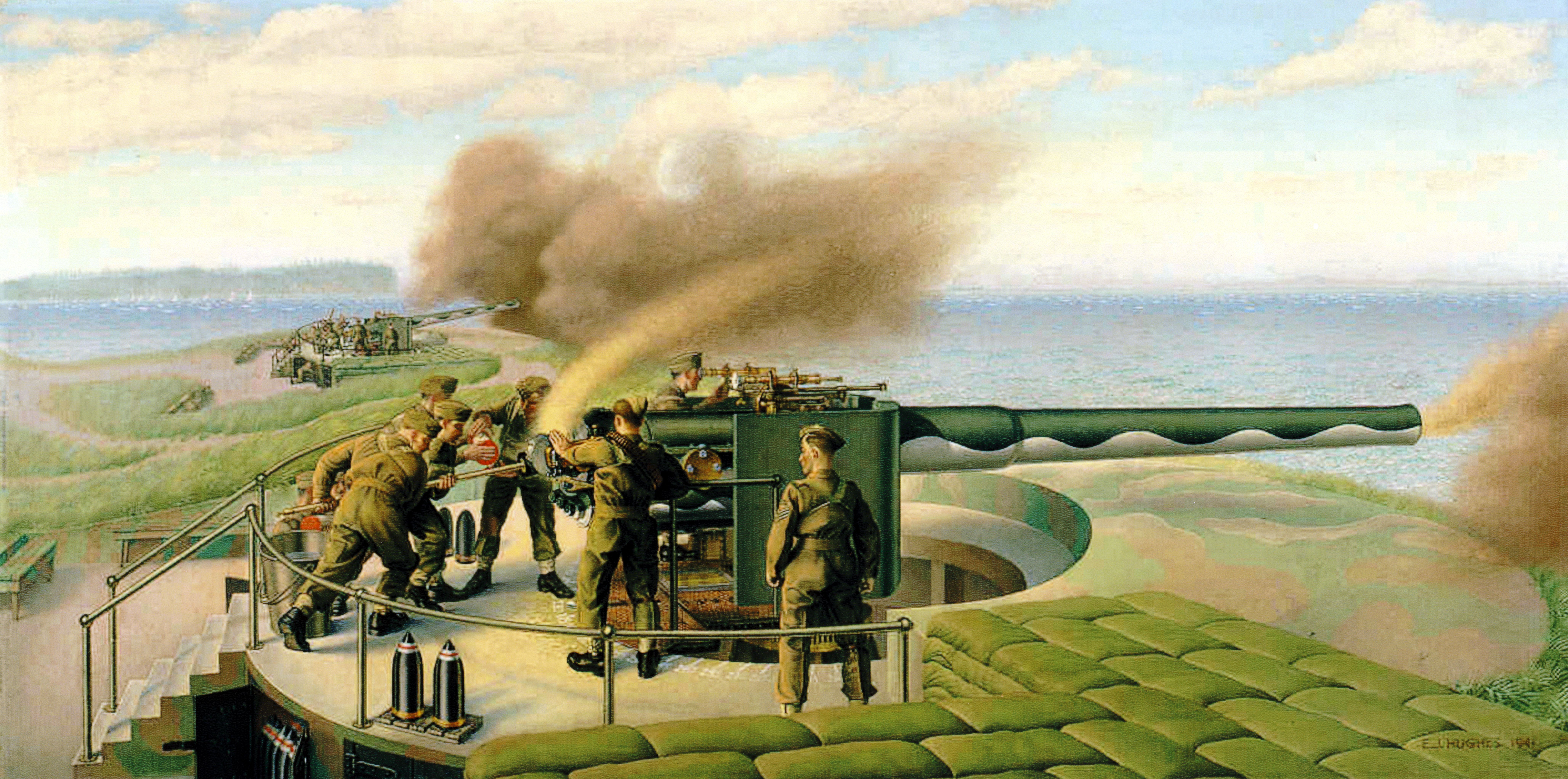
A painting depicting seven soldiers operating a large cannon along the sea coast.
E.J. Hughes (1913-2007) Image Courtesy of 15 Field Regiment Royal Canadian Artillery Museum and Archives.
Although the peninsula had been reserved for the defence of the First Narrows and Burrard Inlet in the 19th century, this federally-owned land had been leased to the city for a nominal sum since 1887. Most people knew the peninsula only as a public park.

In 1914, at the start of the First World War, the point of land near Siwash Rock was occupied by a temporary gun battery when an attack by Germany’s East Asia naval squadron was considered likely. During the Second World War, the Japanese navy was regarded as the greatest threat. A concrete, two-gun battery emplacement with supporting structures on Ferguson Point was planned in February 1938, after Parliament approved construction of permanent coast defences for the harbour in early 1937. Vancouver’s role as Canada’s principal Pacific Coast port and as the transcontinental railway’s terminus justified extra protection from hostile warships.

Vancouver’s Town Planning Commission did not approve of the use of Ferguson Point for the battery, calling it “a favourite beauty spot in the park.” The Vancouver Sun joined the opposition, stating that the gun battery could become “a permanent blot on the scenic beauty of the area.” However, the Parks Board had consented to the new installation and the land was federal government property. Federal authorities deemed the battery “essential” for strategic reasons and construction began in mid-February 1938. The fort was completed in November 1939.

Vancouver’s fixed coastal defences were to be manned by the 15th Coast Brigade of Artillery, a local militia regiment. In anticipation of war, the brigade’s 31st Battery occupied the site on August 27, 1939. The Fire Commander’s Orders of October 1942 stated that the Stanley Park Battery was to guard “English Bay and the First Narrows entrance to Burrard Inlet,” and also to act as a detaining battery for ships awaiting inspection and clearance before entering the Port of Vancouver.
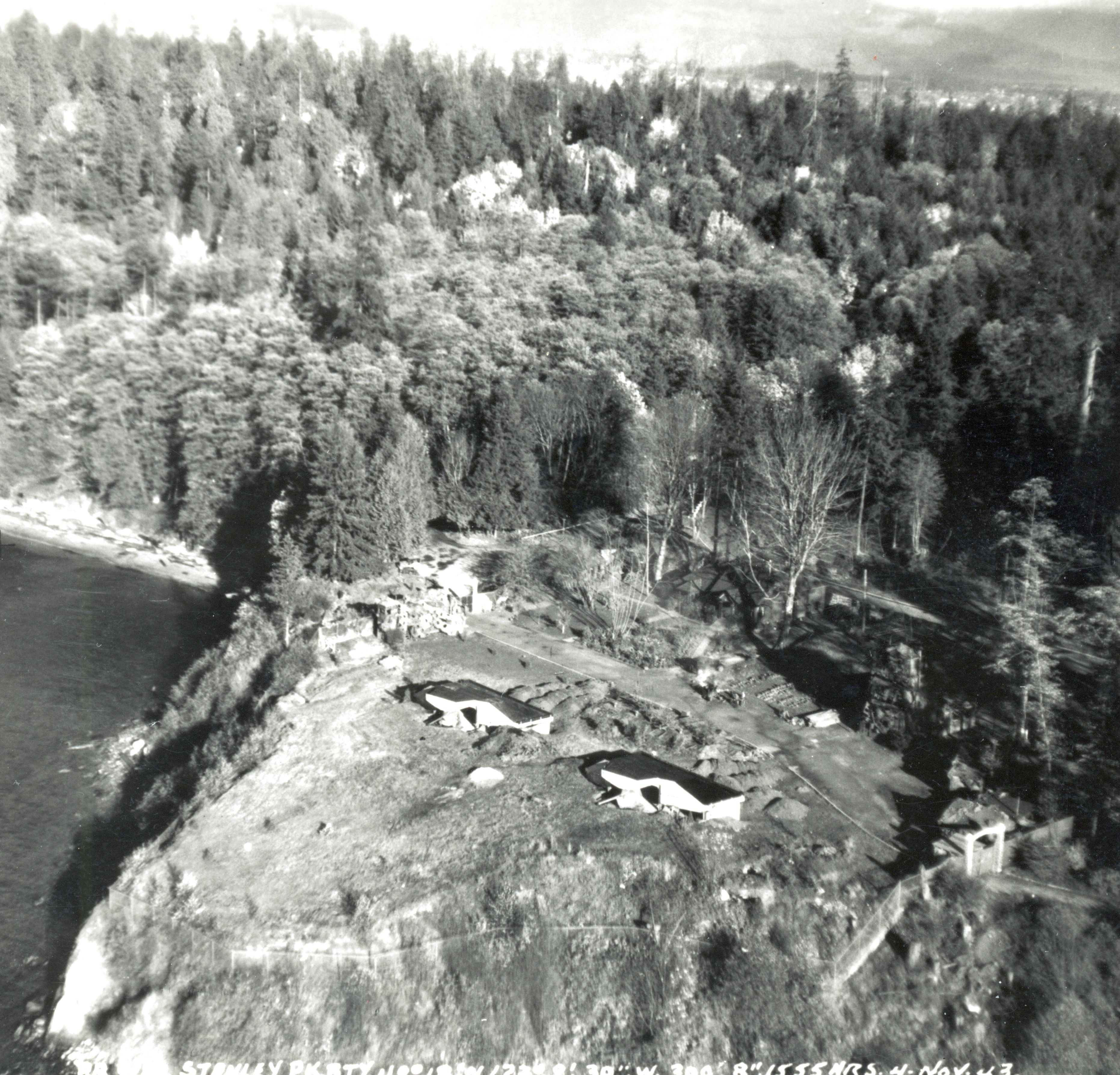
An aerial view of the Stanley Park battery depicting late-war concrete housings over the 4.7-inch guns. Photo courtesy 15 Field Regiment Royal Canadian Artillery Museum and Archives.
Like the smaller battery on the north side of the First Narrows, the Stanley Park Battery was authorized to fire on ships that refused to submit to inspection or that sailed into the port without stopping. An examination vessel (X-Vic) was stationed two kilometres west of Ferguson Point to inspect incoming ships. After Point Atkinson’s signal station had identified arriving vessels, they proceeded to the X-Vic to be cleared for entry into the port. Large ships flew recognition signals that identified them as friendly vessels.

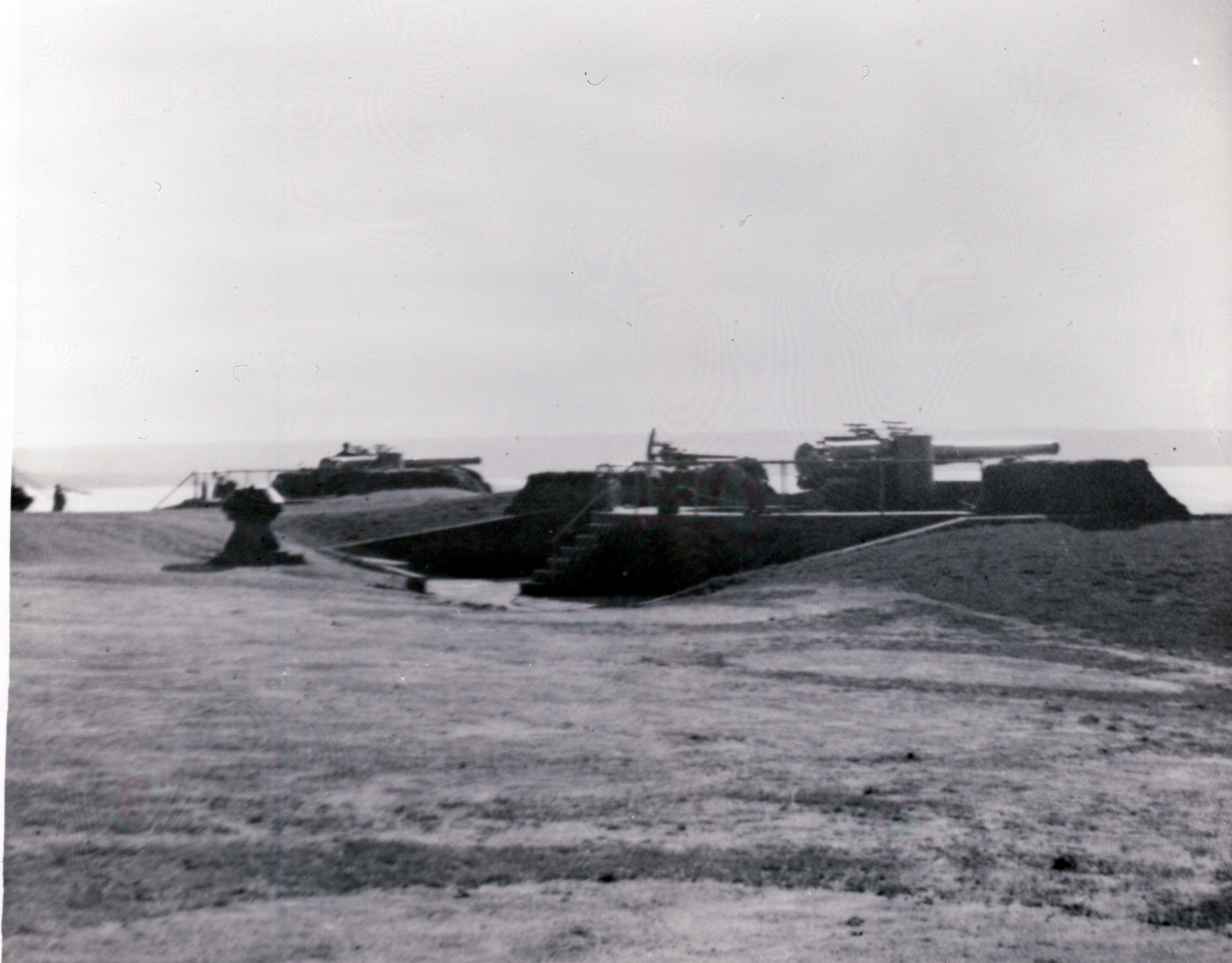
The Stanley Park Battery was originally armed with two breech-loading, 6-inch-calibre guns on circular, concrete pedestal mounts. In 1942, they were replaced with 4.7-inch-calibre guns placed forty metres in from the cliff’s edge. Overhead protection and a back wall were added later.

Ammunition was stored in an underground magazine behind the guns and a concrete three-storey battery observation post (BOP) directed the guns’ fire. Personnel in the BOP also maintained communications with other batteries and co-ordinated three searchlights, two of which were placed close to the water, illuminating English Bay at night.

The searchlights and power generators were maintained and operated by the 1st Searchlight Regiment’s 3rd Battery and by military engineers, with a camp for 140 men sitting on the present Third Beach parking lot. All buildings and emplacements were camouflaged, including the BOP, which had an evergreen tree was painted on its front.

With the destruction of most of Japan’s major warships in 1942-43, the threat of an attack by surface vessels on Vancouver diminished. Although Japanese submarines still torpedoed ships and shelled sites along the West Coast, Vancouver’s defences were reduced to maintenance status in 1944.

Stanley Park’s guns and most of the wooden buildings were removed in September 1945; however, The Vancouver District’s army commander continued to occupy the former officers’ mess as his home.

Following the war, the Vancouver Parks Board demanded Ferguson Point’s complete restoration to parkland. In April 1948, the board won this battle and the gun emplacements were levelled and buried. The BOP was demolished later.
These 6-inch guns were installed in Vancouver’s Stanley Park in early 1938 and later relocated to Yorke Island. While many residents, and a local newspaper, objected to the plan, federal authorities deemed the site strategically “essential.” Photo courtesy 15 Field Regiment Royal Canadian Artillery Museum and Archives.
Remnants of the battery still exist today in Stanley Park, but are not obvious to most. The one remaining searchlight position at Siwash Rock is now the base for a viewing platform. On Ferguson Point, only the old officers’ mess survives as a part of today’s Teahouse in Stanley Park Restaurant, a bustling venue with a breathtaking view of the coast.

By Major (Retired) Peter Moogk, PhD, retired Professor Emeritus of history at UBC, and Curator of the Museum and Archives of the 15th Field Regiment, RCA.