Robert Farley, author of the Battleship Book and senior lecturer at the Patterson School of Diplomacy and International Commerce at the University of Kentucky has compiled a list of five wars the U.S. should never have fought.
By:
Robert FarleyNovember 8, 2015
In the debate that preceded the 2003 Iraq War, we became enamored of the distinction between “wars of choice” and “wars of necessity.” Opponents of the Iraq War decried it as a “choice,” while supporters insisted on its “necessity.” Unfortunately, like many aspects of that debate, that framing was entirely wrong; America has faced vanishingly few wars of “necessity,” but some of our wars of “choice” have nevertheless been good choices. Some, sadly, have not.
As we would expect of any country, not all of America’s wars have been wisely fought, and not all of them were wise to fight. Here are five wars that the United States could have, and should have, stayed out of.
War of 1812:The American Revolutionary War took place against a background of Anglo-French conflict and competition. The French Revolution of 1789 only exacerbated this conflict, threatening to draw the weak, distant American republic into a colossal European War. Although the Adams administration become tangentially embroiled with the French in the late 1790s, the United States largely succeeded in staying out of the war, at least until 1812.
U.S. grievances in the War of 1812 were legitimate, if not overwhelming; British ships were impressing U.S. sailors, and Great Britain was stirring up trouble among Native Americans on the frontier. The war also had an opportunistic element, however, as many American policymakers saw Canada (or what would become Canada) as the unfinished business of the Revolutionary War.
It turned out that the United States was ill-prepared for the conflict. The invasions of Canada failed; U.S. Navy frigates scored some notable successes, but in general the Royal Navy did what it wanted, when it wanted;
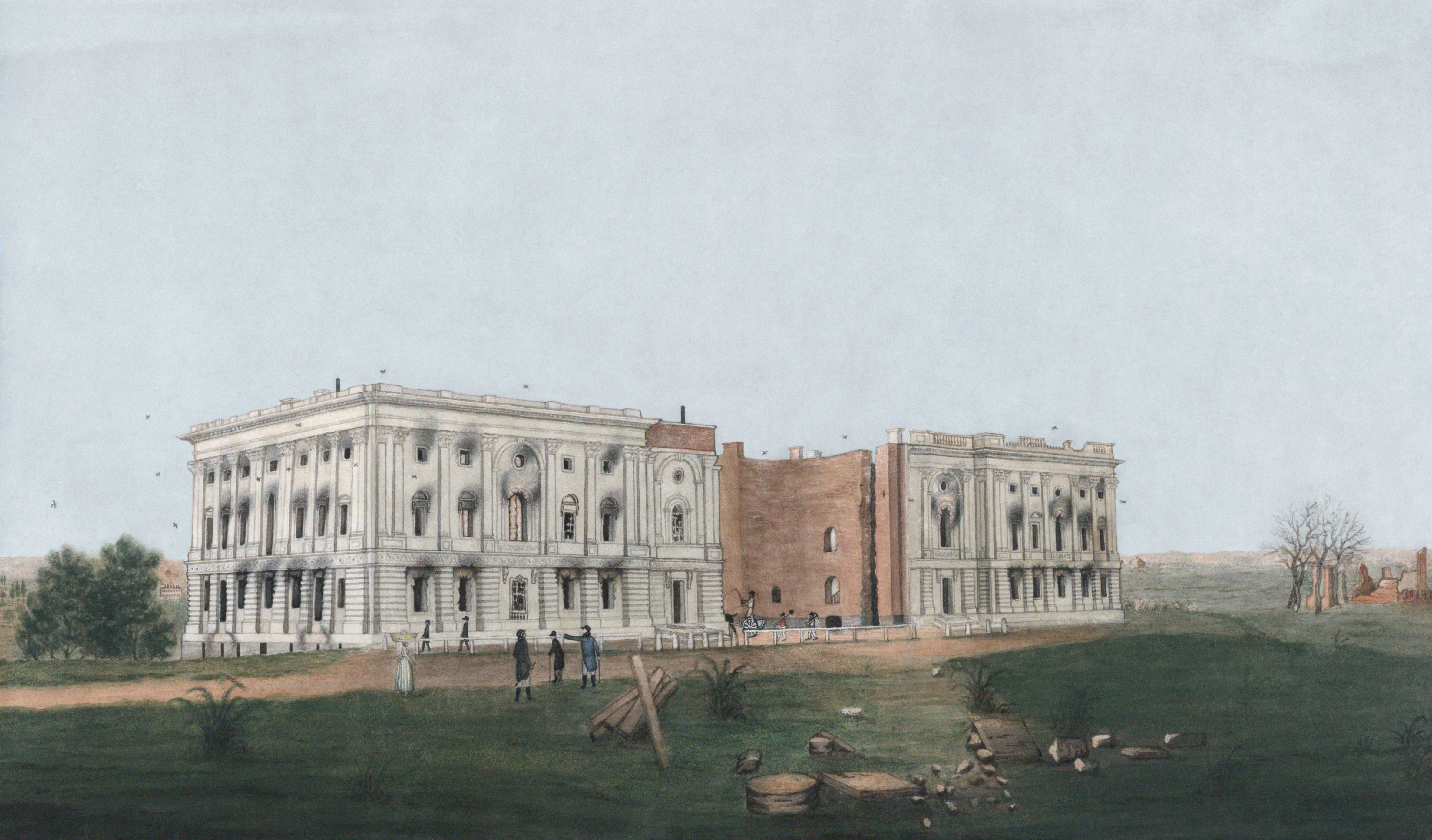
the British burned the American capital, with only heroic resistance preventing the incineration of Baltimore. The Republic nearly collapsed from internal dissension before Washington and London made peace.
The Black Hills War:For the first 120 years of its existence, the United States government waged nearly continuous warfare against the Native American tribes that lived on the Western frontier, (and sometimes within U.S. jurisdiction). In some cases these wars came as a result of Indian attacks against settlements; in others, the wars were purely acquisitive efforts to gain territory and resources.
One of the most poorly conceived of these wars began in 1876. The Black Hills War came about because of white settler encroachment on lands allocated, by treaty, to the Cheyenne and Lakota Sioux. The U.S. government was unable (and largely unwilling) to restrict white migration into the Black Hills, and after unproductive negotiation simply decided to seize some of the most valuable area.
The war resulted in one of the most serious U.S. military defeats of the Indian Wars, the annihilation of the Seventh Cavalry at the Battle of Little Bighorn. Eventually, however, a combination of military and diplomatic efforts forced most of the Cheyenne and Sioux to surrender, apart from a portion that fled to Canada. Sporadic fighting would continue for another fifteen years or so. In the end, the U.S. government “pacified” the Cheyenne and Sioux (who were in the process of becoming more agrarian in any case), and assumed full control over the eastern half of what would become South Dakota. The death and destruction caused by the war provided an appropriate coda for U.S. mistreatment of Native American tribes across the 19th century.
The Great War:When war broke out in Europe in August 1914, American policymakers correctly saw the conflict as primarily a European affair. Despite the fact that the United States had the world’s largest economy, official Washington had not yet come to the conclusion that it bore responsibility for global stability and conflict resolution. Accordingly, the United States watched, and profited from, the slow incineration of European civilization between 1914 and 1917.
President Woodrow Wilson promised, in the 1916 election campaign, to stay out of the war. German submarines and an ill-advised effort on the part of the German foreign service to enlist Mexico’s support in the war changed that position. In eighteen months of war (with the most intense fighting concentrated in the summer of 1918), 116,000 Americans died. Scholars still debate whether U.S. intervention was decisive, but in the end the war resulted in the collapse of four empires (Germany, Russia, Ottoman, Austria-Hungary) and the aggrandizement of two others (Britain and France) without resolving any of the central issues of dispute.
Vietnam War: From the mid-1940s on, U.S. policymakers kept tabs on the developing war in Southeast Asia. The first stage of this war involved a Vietnamese insurgency against the Japanese occupation. The second stage saw this insurgency transition to fighting against French colonial authorities. After the historic victory of Viet Minh forces at Dien Bien Phu, the French made clear their intent to withdraw.
From that point forward, the United States inexorably drew itself into the conflict. It helped prevent the unification of the country under Communist rule in the 1950s; supported the regime of Ngo Dinh Diem until it didn’t; launched a strategic bombing campaign designed to bring Hanoi to its knees; and finally became engaged directly, on the ground, against Viet Cong and North Vietnamese troops.
To what end? The United States withdrew from South Vietnam in 1972, having established a state that could at least, for a time, protect itself against internal guerillas. South Vietnam could not protect itself from the North, however, and a 1975 offensive quickly rolled up the country. That conquest produced tremendous humanitarian suffering, but not much beyond what the war itself had produced in the previous decade.
Today, the Socialist Republic of Vietnam enjoys a growing diplomatic, military, and economic relationship with the United States, and
may become one of the bulwarks of the American strategy to contain the People’s Republic of China.
Operation Iraqi Freedom:In 2003, the United States invaded Iraq in order to topple the regime of Saddam Hussein, establish a friendly, democratic state in its place, and prevent the distribution of weapons of mass destruction to Iraqi-affiliated terrorist networks. In hindsight, every aspect of that sentence seems absurd.
The United States won a convincing victory against Iraqi military forces in the first weeks of the war, but could not establish order in the country. Iraq quickly devolved into various stages of civil war, at immense human and economic cost. Extensive investigation in the wake of the invasion found no serious WMD program, and no meaningful contacts with the Al Qaeda terror network.
After a surge of troops in 2007 contributed to a reduction of violence in the country, the United States withdrew most military forces. The new Iraqi government controls some of its territory, but has struggled to contend with ISIS, and remains deeply vulnerable to Iranian influence. The United States itself has become remarkably intervention-averse,
with even GOP presidential candidates reluctant to express support for the decision to go to war.
Conclusion:
Avoiding bad wars is perhaps the most important responsibility of leadership. Among George Washington’s chief warnings in
his Farewell Address was that the United States should take great care to stay out of unnecessary wars, and aloof from foreign entanglements. America’s leaders would be best advised to pay great heed to this advice when they consider further foreign adventures.
Robert Farley, a frequent contributor to TNI, is author of
The Battleship Book. He serves as an Senior Lecturer at the Patterson School of Diplomacy and International Commerce at the University of Kentucky. His work includes military doctrine, national security, and maritime affairs. He blogs at
Lawyers, Guns and Money and
Information Dissemination and
The Diplomat.