Pages

Showing posts with label Soviet States. Show all posts

Monday, 13 August 2012

The Polish-Soviet War 1919 - 1921

Despite having left left the Great War in 1917 so it could complete it's Soviet Revolution, Soviet Russia was back at war within two years against its neighbour, Poland, a neighbour that it has been to war with on numerous occasions.

With the support of the Ukrainian Soviet Socialist Republic, Soviet Russia went to war against the Second Polish Republic and the Ukrainian Peoples Republic over territorial controls of what is modern Ukraine and parts of Belarus.

When the Great War ended in 1918, the Treaty of Versailles only vaguely defined the international borders between Poland and Bolshevik Russia.

Jozef Pilsudki
Poland's Chief of State, Jozef Pilsudki believed that 1919 was the perfect time for Poland to expand it's borders as far East as possible, then lead a Polish Intermarum federation against the Russian Imperialists.

Yavhen Petrushevych
Vladimir Lenin, saw Poland as a strategic gap that had to be filled for the Red Army to assist other Communist movements in Eastern Europe. By 1919, polish forces had successfully taken control the majority of Western Ukraine, having emerged victorious from the Polish-Ukrainian War. The West Ukraine People Republic led by Yavhen Petrushevych tried to create a Ukrainian state on territory claimed by the Poles, the Ukrainians, and the Russians.

With the Russian civil war turning in favour of the Bolsheviks, the Poles and Ukrainians set aside their differences to defend themselves against the advancing Red Army.
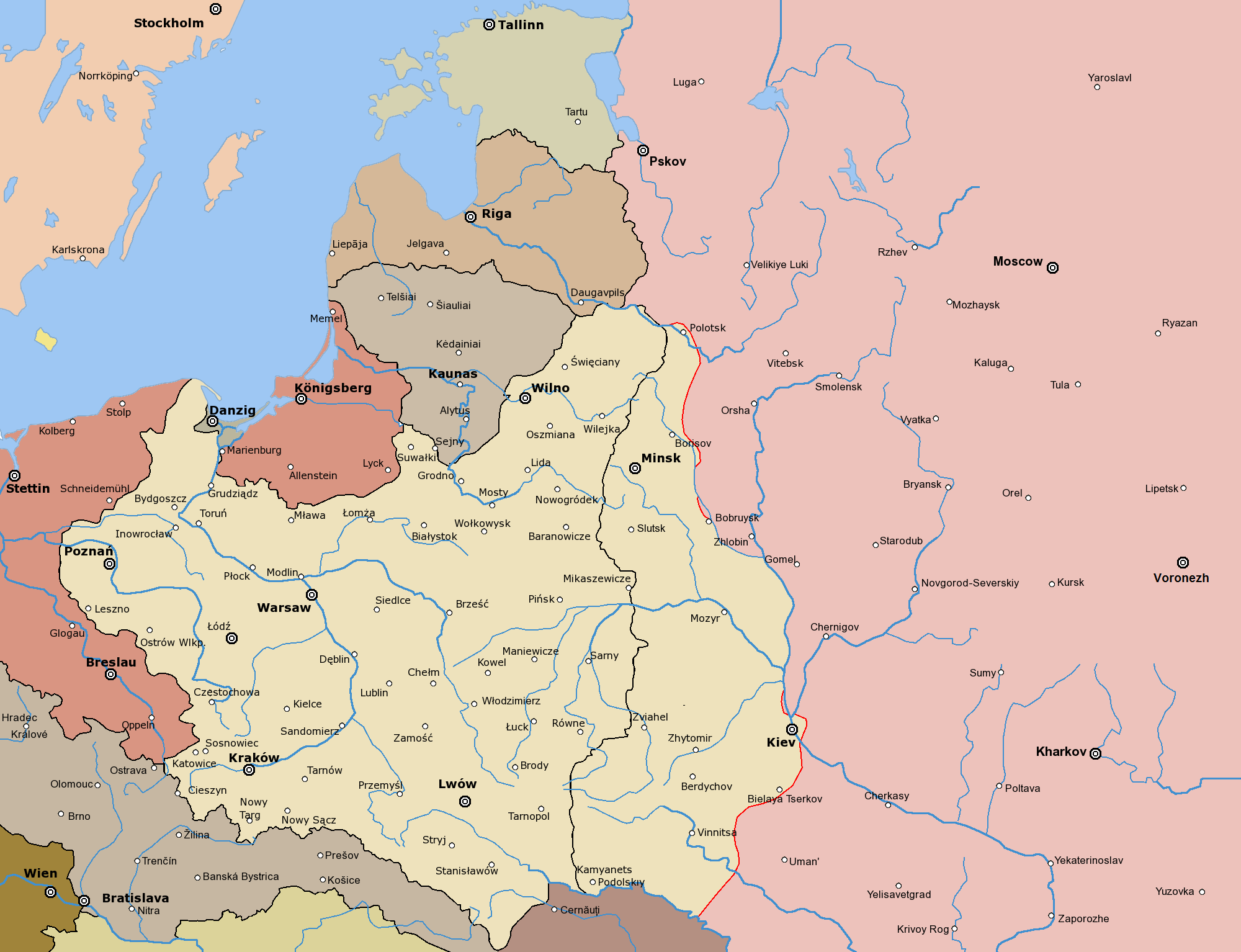
File:PBW June 1920.png
Polish Offensive Early 1920

The Red Army had initial success in early 1920, but was quickly met by swift Polish counter attacks, resulting in heavy losses on both sides. With a quick sweep, the Red Army pushed its way into the Polish capital of Warsaw, causing fear among Western nations, as the German's and Russians did not get along, and their were getting close to one another.
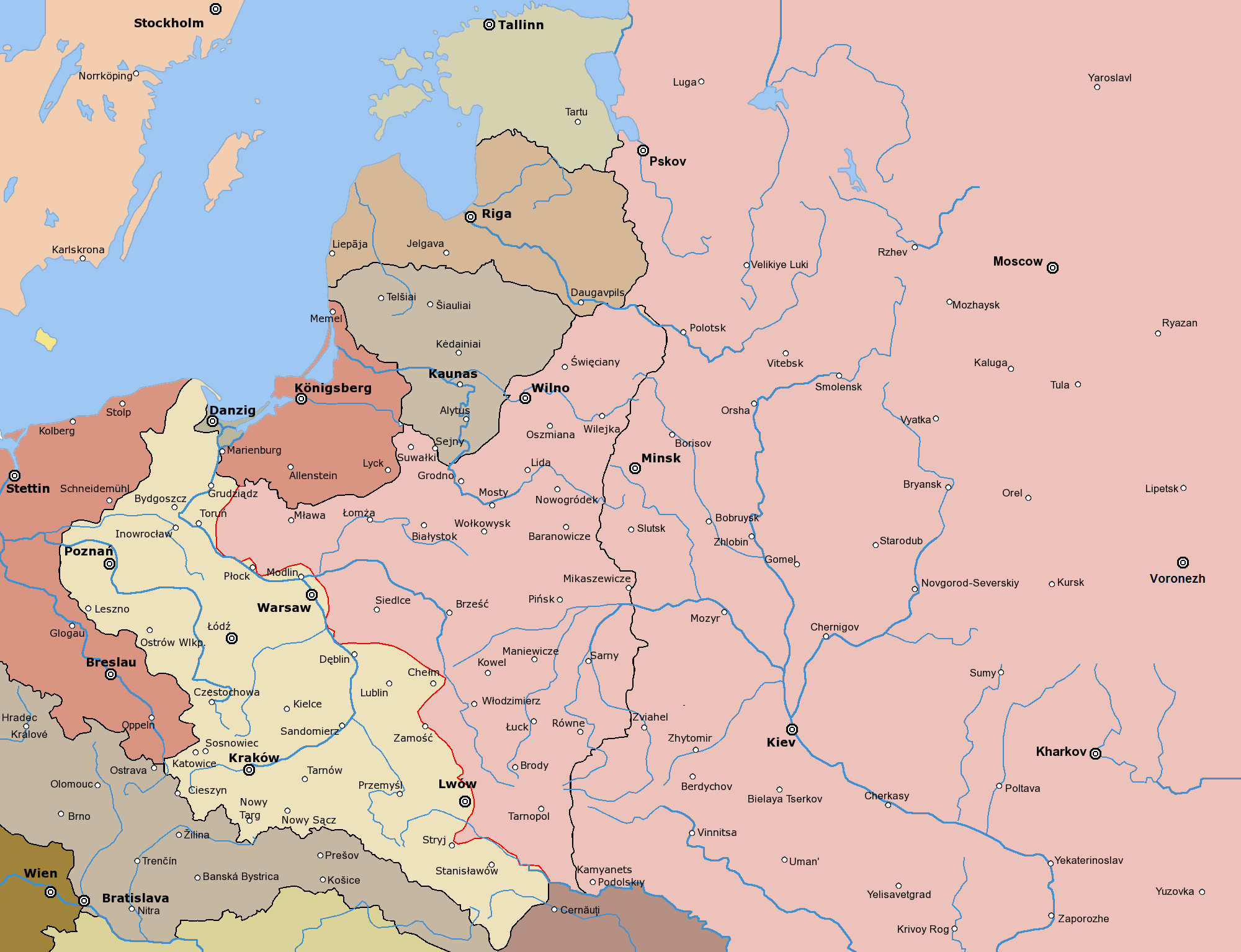
File:PBW August 1920.png
Russian Offensive Summer 1920


By midsummer 1920, the total fall of Warsaw seemed inevitable, but by late August,  Polish forced achieved a decisive victory and began to advance eastward until the Soviets sued for peace and the war ended in October 1920 with a ceasefire agreement.

A Formal treaty, the Peace of Riga was signed on March 18, 1921 dividing the disputed territories between Poland and Russia. Much of the territory ceded to Poland would become part of the Soviet Union following World War Two.

The war left nearly a hundred thousand dead and nearly three hundred thousand wounded. At it's peak during the Battle of Warsaw, there were nearly 1.6 million troops in combat.

To learn more about the Polish-Soviet War, please see:

White Eagle, Red Star: The Polish-Soviet War, 1919-20 (1972) by Norman Davies

Remembering History - The Polish-Soviet War 1919-1921

Tuesday, 7 August 2012

Soviet State Vs. Soviet State - The South Ossetia War of 2008

When the collapse of the Soviet Union occurred in December of 1991, it left several new countries to emerge from under the dust of the collapsed Iron Curtain. One of these new countries, Georgia, located on the northern side of the Black Sea became a strategic centre for the Russian Navy, as it was the key for granting access to the Mediterranean Sea to the Russian Fleet.

Almost immediately following the creation of the State of Georgia, the province, (Oblast) of South Ossetia declared its independence from Georgia, wishing to either be an independent state, or return to being part of the Russian Federation. Georgia did not recognise the independence of South Ossetia and went to war with the province for nearly a year and a half between 1991 and 1992. The war ended with a majority of the province surviving under a de-facto Russian supported government. A similar war took place with the Abkhazia Oblast throughout 1992 and 1993 which only made matters more intense.

Other than the odd skirmish, the conflict laided dormant until 2008 when separatist talks were heard from both South Ossetia and Abkhazia, and Georgia threatened military intervention should either province attempt to leave. The Russian Federation saw this as a threat to their military strategy in the Black Sea, and officially decided to defend South Ossetia and Abhazia from a potential Georgian attack.
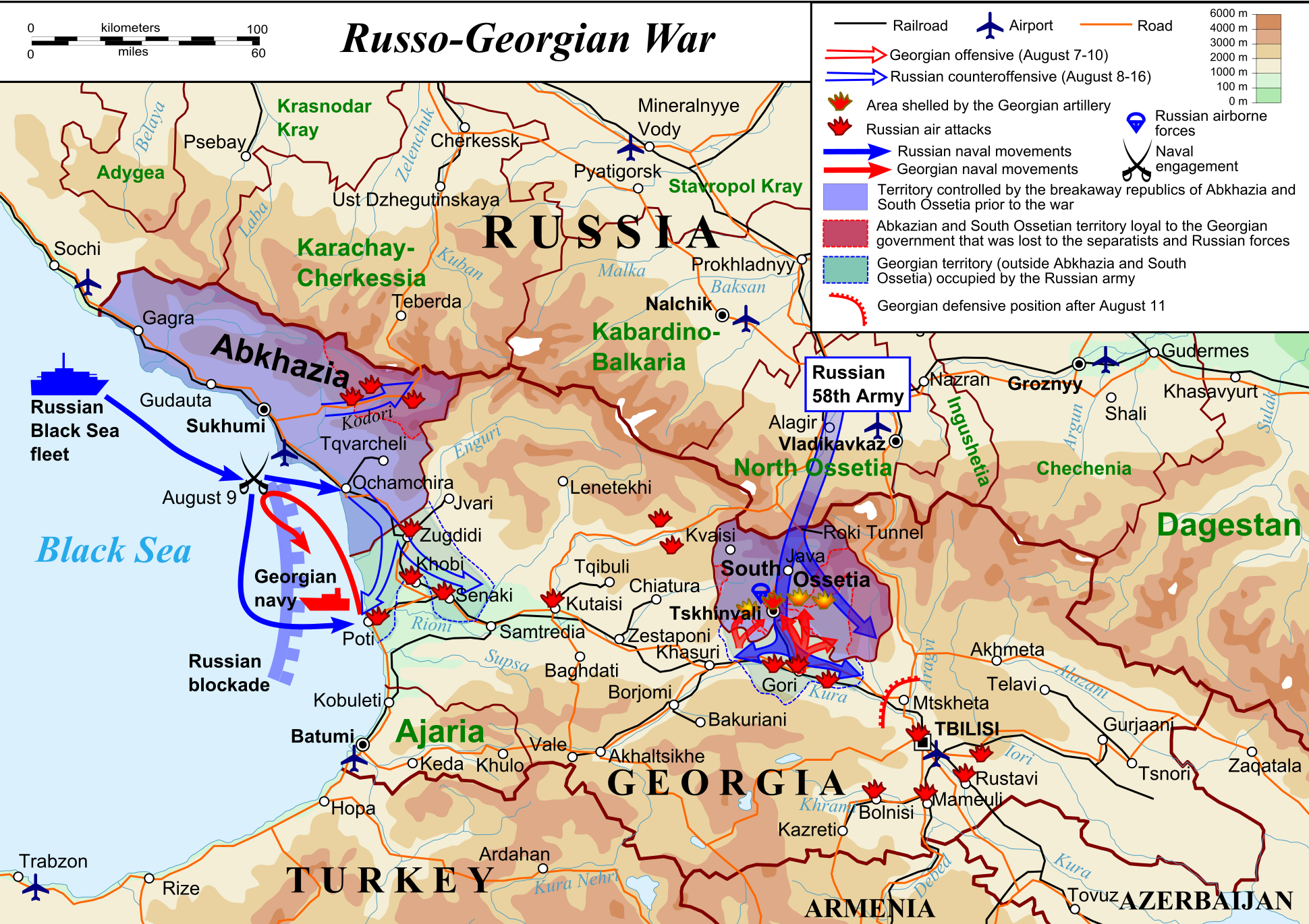
File:2008 South Ossetia war en.svg
CC 3.0 
Believing that the Russian support was a bluff, Georgia attacked on August 7-8 2008 in an attempt to regain the territory which had been under Russian military control for nearly two decades. Georgia claimed its attacks were retaliation for attacks against its peacekeepers in South Ossetia, and called for International support because Russia was deploying non Peacekeeping forces.

The Georgian assault forced the Russian peacekeepers to defend themselves with the support of the Ossetian militia. This led to the Russian Federation to view the assault as an assault on their sovereignty, and the rights of South Ossetians to cede Georgia and join Russia. Within hours of the first attacks, Russia deployed its 58th Army and its Airborne troops claiming humanitarian intervention and peace enforcement.

On August 9, Russian marines landed in Abkhazia and with the support of the local Militia opened a second front against the Georgian army. The Georgian navy was defeated in a naval skirmish earlier in the operation. Georgian forced began to retreat, and Russian forced easily occupied a number of Georgian port cities.

On August 12, a ceasefire agreement was put forward by the French president, and the European Union. Georgia signed the agreement on August 15, and Russia on August 16. Russian troops created a buffer zone around Abkhazia and South Ossetia, as well as recognising the governments of both provinces as independent nations. Recognition also came from Venezuela, Nicaragua,  and the south Pacific Island nations of Nauru, Tuvalu, and Vanuatu. Belarus was in the process of recognising South Ossetia, when it was urged to refrain for such action by the European Union.

Remembering History - The 2008 South Ossetia War, a.k.a The Russo-Georgian War