Pages

Showing posts with label USSR. Show all posts

Monday, 1 July 2013

Operation Greenhouse - Nuclear Test Series 1951

Much of the post war period that was the Cold War, was spent attempting to build a bigger, more powerful, and more accessible nuclear/thermonuclear weapon to deter the enemy from attacking. The Cold War saw the establishment of Churchill's famous "Iron Curtain" dividing the world between the Eastern Bloc and the Western Bloc.

In 1951 the United States conducted its 5th Nuclear test series, code named Operation Greenhouse. As with any scientific test, the United States began experimenting with the concept of thermonuclear weapons, more commonly known as Hydrogen Bombs. This series of tests took place at the newly established Pacific Proving Ground. The test series would encompass four detonations, each mounted on steel towers to simulate areal detonations.

The four tests of Greenhouse represented a new aggressive design of nuclear weapons, looking to take the ultimate weapon one step further. Traditional nuclear weapons were very large in size, weight and required a high amount of fissile material. The ideas behind Greenhouse were to reduce each of the above traditional requirements to build more powerful weapons with less material, making them more operational.

A year and a half before Operation Greenhouse, on August 29 1949, the Soviet Union detonated RDS-1, nicknamed "Joe-1." The test yielded 22 Kilotons, and surprised the world. The United States only detected radioactive fission products days after the blast, and traced them back to the USSR. On September 23rd 1949, President Harry Truman announced to the world that the Soviet Union had successfully detonated an atomic bomb. This statement is considered by many to be the official beginning of the Cold War, as both the United States and the Soviet Union began working on the first Hydrogen Bomb.

The first two tests of Greenhouse, were of traditional nuclear weapons with minor adjustments to the firing mechanism. "Dog" tested on April 8th 1951 yielded 81 kilotons, and "Easy" tested on April 21st 1951 yielded 47 kilotons. It was the last two tests of this series that took major steps forward to designing a Hydrogen Bomb.

"George" was tested on the 9th of May 1951 and was the first recorded thermonuclear experiment conducted by the United States.  "George" was actually considered a thermonuclear burn, due to the addition of a small amount of heavy isotopes of liquid hydrogen (deuterium and tritium) that were injected into the core of the bomb. "George" acted more liked a boosted nuclear bomb than a Hydrogen bomb. The findings from "George" validated the theories that brought about the ideas of a thermonuclear weapon, and would be used when designing "Ivy Mike." "George" yielded 225 kilotons.

"George" Test shot mushroom cloud. nuclearweaponarchive.org

The final test of Operation Greenhouse was "Item." Like "George," "Item" was a test of a boosted fission weapon. "Item" was injected with deuterium-tritium gas into the uranium core.The heat of the gas produced a thermonuclear fusion reaction, but not enough to be fully considered a fusion bomb. The planning behind "George" and "Item" was from the great mind of Dr. Edward Teller in 1947. Teller has designed the idea of a booster to create a more powerful reaction, causing a larger detonation. While much smaller than "George", "Item" yielded 45.5 kilotons, but proved effective in pumping the booster gas into the weapon before detonation. The test was primarily a test of the nuclear principles involved and to gain valuable research data. It was never considered a design for weaponizing a device.

The nuclear discoveries that Operation Greenhouse provided helped the United States design and successfully test "Ivy Mike" in November 1952.  Thermonuclear Weapons would change the face of the Cold War, as would bigger and larger nuclear bombs.

Remembering History - Operation Greenhouse


Monday, 13 August 2012

The Polish-Soviet War 1919 - 1921

Despite having left left the Great War in 1917 so it could complete it's Soviet Revolution, Soviet Russia was back at war within two years against its neighbour, Poland, a neighbour that it has been to war with on numerous occasions.

With the support of the Ukrainian Soviet Socialist Republic, Soviet Russia went to war against the Second Polish Republic and the Ukrainian Peoples Republic over territorial controls of what is modern Ukraine and parts of Belarus.

When the Great War ended in 1918, the Treaty of Versailles only vaguely defined the international borders between Poland and Bolshevik Russia.

Jozef Pilsudki
Poland's Chief of State, Jozef Pilsudki believed that 1919 was the perfect time for Poland to expand it's borders as far East as possible, then lead a Polish Intermarum federation against the Russian Imperialists.

Yavhen Petrushevych
Vladimir Lenin, saw Poland as a strategic gap that had to be filled for the Red Army to assist other Communist movements in Eastern Europe. By 1919, polish forces had successfully taken control the majority of Western Ukraine, having emerged victorious from the Polish-Ukrainian War. The West Ukraine People Republic led by Yavhen Petrushevych tried to create a Ukrainian state on territory claimed by the Poles, the Ukrainians, and the Russians.

With the Russian civil war turning in favour of the Bolsheviks, the Poles and Ukrainians set aside their differences to defend themselves against the advancing Red Army.
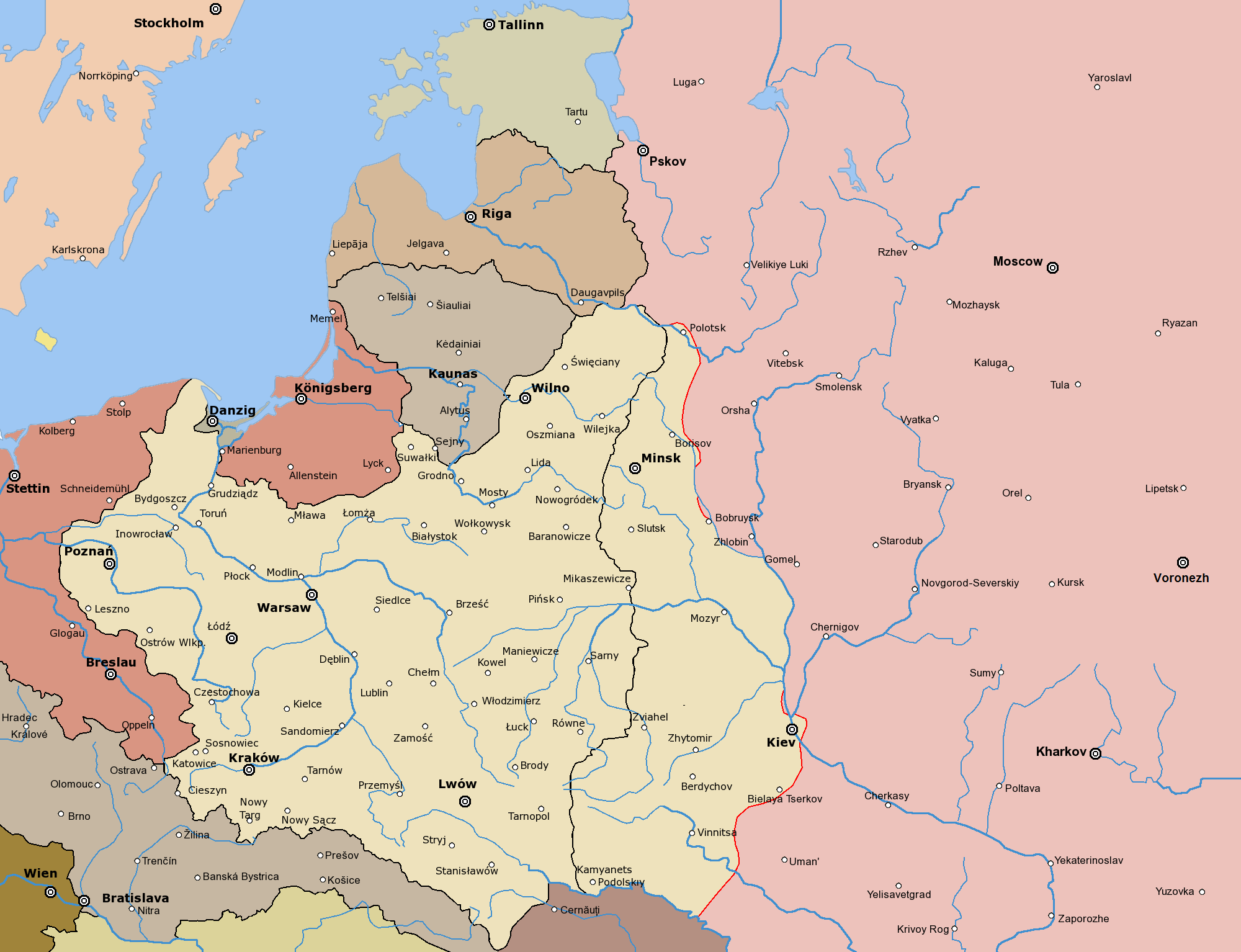
File:PBW June 1920.png
Polish Offensive Early 1920

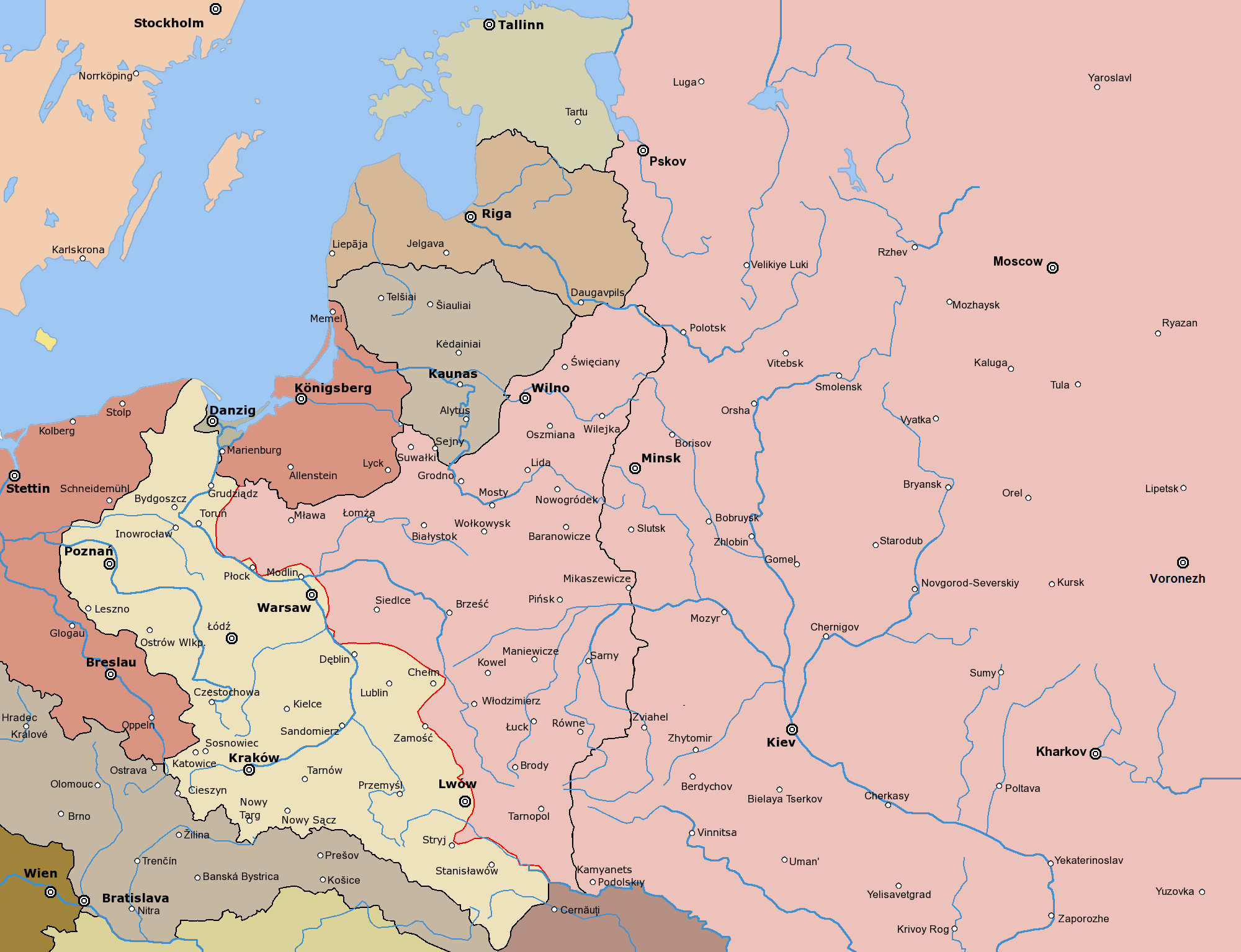
The Red Army had initial success in early 1920, but was quickly met by swift Polish counter attacks, resulting in heavy losses on both sides. With a quick sweep, the Red Army pushed its way into the Polish capital of Warsaw, causing fear among Western nations, as the German's and Russians did not get along, and their were getting close to one another.
File:PBW August 1920.png
Russian Offensive Summer 1920


By midsummer 1920, the total fall of Warsaw seemed inevitable, but by late August,  Polish forced achieved a decisive victory and began to advance eastward until the Soviets sued for peace and the war ended in October 1920 with a ceasefire agreement.

A Formal treaty, the Peace of Riga was signed on March 18, 1921 dividing the disputed territories between Poland and Russia. Much of the territory ceded to Poland would become part of the Soviet Union following World War Two.

The war left nearly a hundred thousand dead and nearly three hundred thousand wounded. At it's peak during the Battle of Warsaw, there were nearly 1.6 million troops in combat.

To learn more about the Polish-Soviet War, please see:

White Eagle, Red Star: The Polish-Soviet War, 1919-20 (1972) by Norman Davies

Remembering History - The Polish-Soviet War 1919-1921

Monday, 16 July 2012

Cold War Cooperation - Apollo-Soyuz Test Project

During what onlookers thought was the rising action of the Cold War, the United States and the Soviet Union were cooperating peacefully in orbit above the earth.

NASA and the Soviet Space command, planned an experimental meeting of two manned space crafts in space. This Apollo-Soyuz Test Project would be the first joint US-Soviet space flight, and the last flight of an Apollo spacecraft.

ASTP patch.png
The Mission Crest (NASA)
On July 15 the two spacecraft were launched within three hours of each other, and met on July 17 1975. Shown to the public as a symbol of detente policy, the two superpowers were realistically marking the end of the Space Race between them that began with the launch of Sputnik in October of 1957.

More than just a friendly "Hello" in space, the mission included joint and individual scientific experiments. The US Apollo crew engineered an eclipse of the Sun to allow the Soyuz team to take pictures of the solar corona for later experiments, as well as to provide useful insight into engineering for future joint space flights. After more than 44 hours together, the shuttles  went there separate ways. The US Apollo craft remained in space for 9 days, while the Soyuz for 5 days.

This test flight provided the knowledge for the Shuttle-Mir Program and the International Space Station docking capability with supply crafts from all over the world.

The docking collar used by the Soyuz would become the main link for the Mir Space Station until its retirement, and the Space Shuttle continued to use the APAS (Androgynous Peripheral Docking System) until 1998 when they changed the docking collar to the PMA (Pressurised Mating Adaptors) system.

The Apollo-Soyuz Test Project was the last manned US spaceflight until April of 1981 with the maiden flight of the Space Shuttle. It was also the only spaceflight of US Astronaut Donald Slayton's career. Originally part of the Mercury Seven in 1959, he was grounded until 1972 for medical reasons.
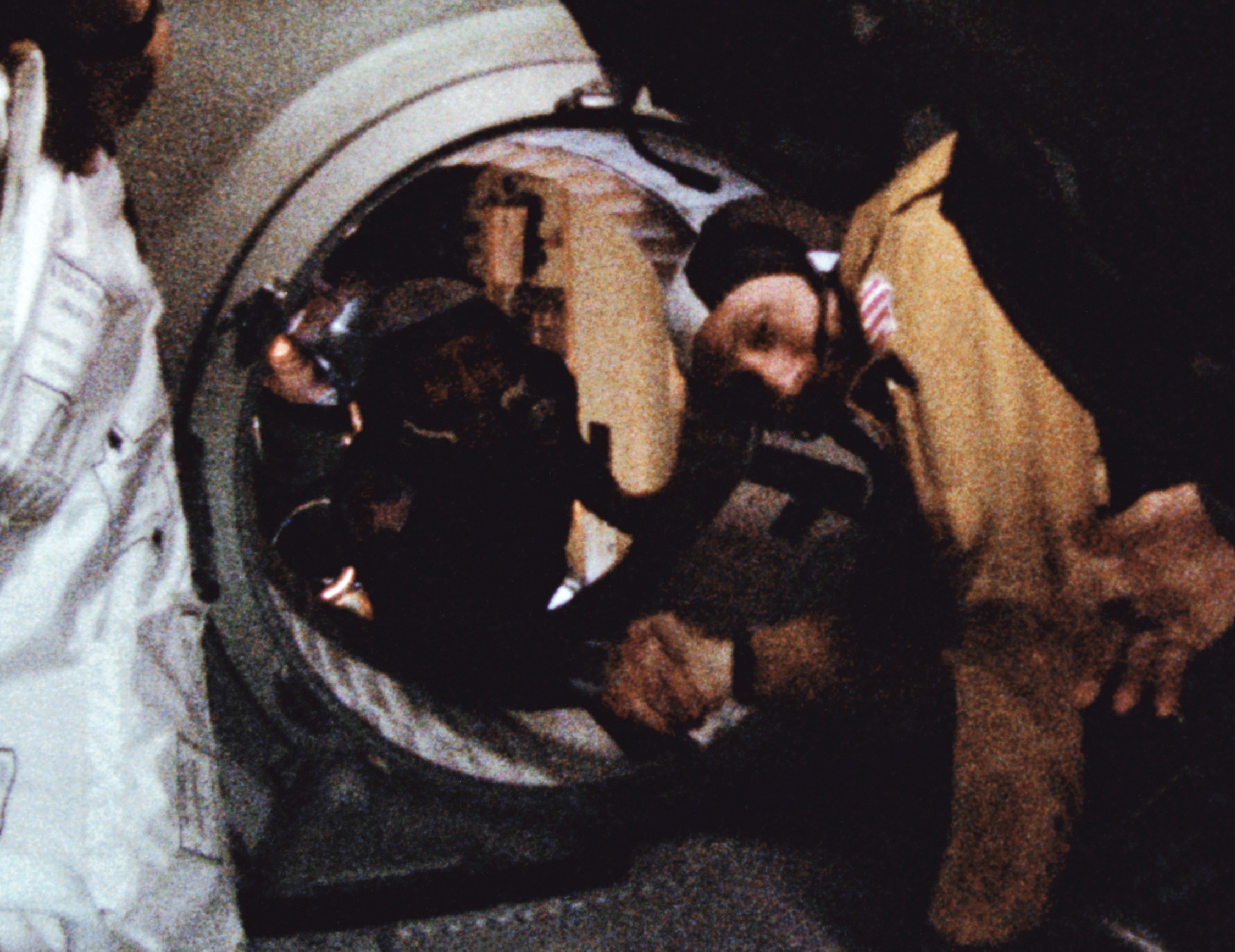
File:ASTP handshake - cropped.jpg
The Historic International Hand-Shake (NASA)

Remembering History - The Apollo-Soyuz Test Flight.