Pages

Showing posts with label France. Show all posts

Monday, 4 February 2013

The Rif War 1920-1926

French and Spanish troops holding a defensive line (1924)


Guerra del Rif 1922 - 2.jpg
Spanish Officers inspect the remains of its Garrison after  the battle of Annual. 

After a long absence, I return with a look at a lesser known conflict, the Rif War fought between Spain with assistance by France against the Republic of the Rif.  The War is also known as the Second Moroccan War.

 As a result of the earlier Treaty of Fez (1912), Spain gained possession of Melillia and Ceuta, both are autonomous Spanish cities in Northern Africa. To ensure the safety of the two cities, General Damaso Berenguer, the Commission of the Spanish cities, decided to conquer territory to the East, which was occupied by the Jibala tribes. The minor classes resulted in little success. The worst of the casualties were taken by Spain itself when its Army was was almost entirely defeated on August 9, 1921, by forces of Adb el-Krim.

The Battle of Annual, as it has become known, led the Spanish to implement colonial policies towards the Rif.  At the end of the battle, 13,363 Spanish were dead and another 7,000 were wounded.

Powered by their victory over the Spanish, the Rif continued to push the Spaniards back. By the end of August, Spain had lost all its territory gained since 1909, and only in control of Melilla. Despite the Rif having Melilla surrounded, Abd el-Krim ordered his troops not to attack the city because of the 14,000 strong Spanish Garrison. el-Krim also worried that other European powers would intervene if their cities where harmed. Melilla, was the centre of Europeans living in Northern Africa.

The low point of the war came in 1924, during fighting at Dar Aquba, when the Spanish military used chemical weapons. It is the second recorded use of mustard gas in warfare. It was previously used in 1915, during the Battle of St. Julien, part of the Second Battle of Ypres. The attack lead to the deaths of 10,000 Rif warriors.

In May of 1924, the French Army fortified the Oureghla River. They worried the Rif War would spill over into its African territory. Eleven months later, the Rif decided to attack the French lines, and show the European powers their true strength. Within two weeks, 40 of the 66 French outposts along the river were stormed and abandoned. The result was 1,000 French soldiers dead, 3,700 wounded, and another 1,000 missing. The loss represented a 20% casualty rate of all French forces in the Rif.


France did not take lightly to the attack by the Rif. They intervened on the side of Spain, and deployed 300,000 well trained and modern equipped soldiers from Metropolitan North Africa, Senegalese and Foreign Legion troops.


File:Landing of Alhucemas.jpg
Spanish troops landing in Alhucemas Bay, 8 May 1925. 
The Final attack of the War came on May 8, 1925. The French and Spanish mounted a 123,000 strong fighting force, supported by 150 aircraft against a force of 12,000 Rifians. As in many Colonial wars, superior numbers and technology would favour the Colonial powers. The French troops attached from the South, while the Spanish force attached the Alhucemas Bay, employing tanks (M48 Patton) the  in an amphibious assault for the first time. The Spanish attack coming from the north, would pin the Rifians between two massive armies. After a year, and a continuing bitter resistance, el-Krim surrendered to French authorities, and Spanish Morocco was re-established.

Remembering History - The Rif War, 1920-1926


Friday, 6 July 2012

The little war that wasn't so little - The "Little War in Hungary"

Just like a book, you cannot judge a war by the name history has given it. This is especially true with the Little War in Hungary, taking place between 1530 and 1552.

The war was a series of conflicts between the Habsburgs and their close allies against the Ottoman Empire.

Belligerents:
  • Habsburg Austria
  • Holy Roman Empire
  • Spain
  • Papal States
  • Bohemia
  • Kingdom of Croatia
  • Hungarian Kingdom of Ferdinand's
Against
  • The Ottoman Empire
  • Moldavia
  • Hungarian Kingdom of Szapolyai's
  • Wallachia Serbain Despotate
  • France
The war is considered to have begun following the Ottoman Siege of Vienna in 1529, where Suleiman the Magnificent attempted to capture the city. The siege took place between September 27 and October 15, 1529, and left more than 15,000 dead or wounded. The Ottoman's failed to capture Vienna, and the tides turned against them, and after almost a century of unchecked conquest, the Ottoman Empire began to loose its gained territory.  It marked the maximum extent of the Ottoman Empire's control and expansion in Central Europe.

File:Siegeofvienna1529.jpg
Wood Engraving of the clash between the Austrians and Ottoman's outside of Vienna in 1529 (PD-OLD)
Following the failed siege, Austria launched a counter attack against the Ottoman in 1530, not an easy feat when facing an defending army of 120,000. Ferdinand of Austria would in the end be successful in capturing the fort at Esztergom along the Danube River, which as a geographical strategic point.

The Austrian success in Hungary frustrated Suleiman to the point that he would attempt to conquer Vienna again in 1532, with an attacking army of approximately 150,000. Ferdinand, realising how massive Suleiman's force was, withdrew his army from the boarder city of Koszeg, and left fewer than 700 men to defend the city, without any canons. The Grand Vizier of the Ottoman Empire, Ibrahim Pasha, did not understand how poorly defended the city of Koszeg was, and placed the city under siege for more than four weeks. With the arrival of the August rains, the Ottoman army withdrew and returned home.

Despite the second failed attempt at capturing Vienna, the Ottoman's and Austrians signed a peace treaty, which recognised the Kingdom of Hungary as an Ottoman vassal, as long as the Ottoman's respected the regions of Hungary that had recognised Habsburg rule.

This peace deal did not end the war between the two rivals. The war would turn bloody again at the Siege of Osijek (1537), where Ferdinand and his massive Austrian army, which was well trained and equipped thanks to the success of his defending force at Koszeg, planned a massive blow to the Ottoman strong hold of Osijek. This attack would directly violate the treaty. At the Battle of Dakovo, the Austrian attempt would be futile, and faced a crushing defeat, leaving more than 25,000 Austrians dead or wounded and minimal loses to the Ottoman defencive force. Less than a year later at the Battle of Preveza, in 1538, the Ottoman army would again crush the Habsburg led coalition.

Looking to make up for the humiliating defeats of the previous two years, the Austrians would attempt to capture Buda in 1541. The Habsburg's luck was still no where to be found. After the humiliating defeat at the Siege of Buda, the Hungarian King (Disputed) John Szapolyai  died in 1540, and an appeal by his widdow to end the war went unanswered.

By 1543, it was clear the Ottoman Empire would win this war. Their alliance with France was stronger than ever, and France even agreed to aid the Ottoman army during the Campaign of Suleiman in 1543, supplying troops,  and artillery units. These played a direct role in the success of the Ottomans at the Siege of Esztergom and the capture of Hungarian cities Szekesfehervar, Siklos, and Szged, and the protection of another Austrian attack on the city of Buda.


Fine Art Print of The Siege of Esztergom in 1595 by German School


The Siege of Esztergom in 1595 (Bridgeman Art Library / Bibliotheque Nationale, Paris, France / Archives Charmet)

At the end of 1543, the Ottoman's and Austrians came to another peace agreement, which would last until 1552 when Suleiman decided he required the city of Eger to be within the limits of the Ottoman Empire. It was a humiliating defeat, where a professional army was defeated by the citizens of Eger withstanding the annexation.

While other conflicts between the Ottoman Empire, Austria, and Hungary would arise, this ended the Little War in Hungary. Especially as this was just one of the many Ottoman-Habsburg Wars

For more information on this subject, please read:

  • The Ottoman Empire 1326-1699 by Stephen R. Turnbull (2003)
  • The Enemy at the Gate: Habsburg, Ottomans, and the Battle for Europe by Andre Wheatcroft (2010)
  • Plus all the other great books on Ottoman and Austrian history

Remembering History - The Little War in Hungary 1530-1552

Thursday, 5 July 2012

The "Seven Years War" as the First World War

After being approached by a student to help study for the AP  (Advanced Placement) exam, I was set on a study course reviewing the "Seven Years War" and realised, that it was truly the First World War. I state this, in no way meaning any disrespect for the Great War, now commonly known as the First World War, but in a revisionist way to prove that the "Seven Years War" was a world war.

 The Defeat of the French Fireships attacking the British Fleet at Anchor before Quebec, 28 June 1759 The Canadian War Museum  
Militarily speaking, the Seven Years War was truly a World War. Just look at the basics of the conflict. It took part between 1756 and 1763, and included almost every great power of the time, and battles raged in Europe, North America, Central America, West Africa, India and in the Philippines. Just the geographic locations of the Seven Years, by definition make the conflict a World War.

If you have never heard of the Seven Years War, it may be because historiography in every country involved has given the conflict a number of alternative names based on the theatres of combat.
  • Known as the French-Indian War (1754-63) in North America (France, Britain, and the Iroquois)
  • Known as the Pomeranian War (1757-63) in Sweden and Prussia
  • Known as the Third Carnatic War (1757-63) on the Indian subcontinent
  • Known as the Third Selesian War (1756-63) in Prussia (yes, they have two names for one war) and Austria.
  • Known as the Spanish-Portuguese War (1761-63) in Spain and Portugal
  • Known as the Anglo-Spanish War (1761-63) in Britain, in their war against Spain.
  • and; known as the War of the Conquest (1754-63) in French Canada (Quebec)
If you are scratching your head because the math does not work out, 1754 to 1763 is 9 years, and not 7, your math is correct. The name, The Seven Years War was selected because The Nine Years War was already taken for a war between Louis XIV of France and a European Coalition (1688-1697).

The war began with the divide between Great Britain (The Hanover's) and France and Spain (The Bourbons), as well as the divide between the Prissian's (The Hozenzollerns) and Austria (The Habsburgs). These divides, as well as numerous alliance systems would divide the world and their colonies against each other.

First Alliance:
  • Kingdom of Prussia
  • Kingdom of Great Britain
  • Electorate of Hanover
  • Brunswick-Wolfenbuttle
  • Iroquois Confederacy
  • Kingdom of Portugal
  • Landgraviate of Hesse-Kessel
  • and; Schaumburg-Lippe
Second Alliance:
  • Kingdom of France
  • Habsburg Monarchy
  • Russian Empire
  • Kingdom of Spain
  • Kingdom of Sweden
  • Electorate of Saxony
  • Mughal Empire
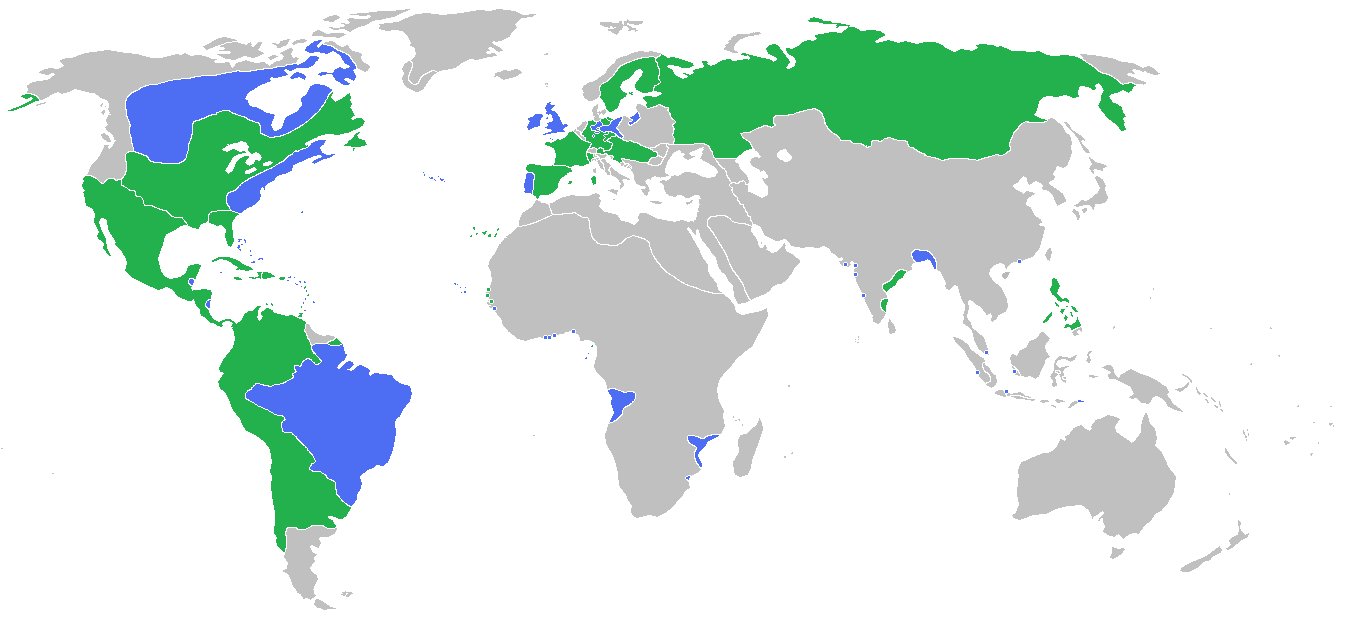
File:SevenYearsWar.png
A Map of the Alliance System during the Seven Years War (CC BY 3.0)
Without going into great detail on the War, because you can read a book on that, my intent is just to showcase the global affects of the Seven Years War, thus proving that it was technically the First World War.

UPDATE: There are some that believe that The Seven Years War cannot be considered a World War because it did not include what has become known as "Total War" where the entire societal apparatus is used to further the war effort. I disagree that this is a requirement for a World War. When I use the term, World War, I am discussion geographic combat, and in that sense, the Seven Years War, was a World War.
The War ended with four treaties:

  1. The Treaty of Saint Petersburg (1762) - Which ended the Seven Years War between Prussia and Russia. It was a mutual agreement in the simplest terms to end the war with each other, so they could better fight their other enemies.
  2. The Treaty of Paris (1763) - Which ended the Seven Years war for Great Britain, Prussia, Portugal and their allies against France, Spain, Austria, Russia and their allies.
  3. The Treaty of Hubertusburg (1763) - Which ended the Seven Years war between Prussia, Austria, and Saxony. It was a side treaty of the Treaty of Paris (1763).
  4. The Treaty of Hamburg (1762) - Which ended the Seven Years War between Sweden and Prussia.
The war ended as most do, with territorial changes around the world. Much of Europe returned to its pre-war boundaries and conditions. It was the colonies that could change hands between Britain, France and Spain.
  • Great Britain would annexes (what would be) Canada (Then New France), Begal and Florida.
  • France would transfer Louisiana to Spain.
For more information on the Seven Years War, please read any of the following:
  • Northern Armageddon: The Battle of the Plains of Abraham by D. Peter MacLeod (2008)
  • The Seven Years War in Europe: 1756-1763 by Franz A.J. Szabo (2000)
  • Crucible of War: The Seven Years War and the Fate of Empire in British North America, 1754-1766 by Fred Anderson (2001)
  • The Global Seven Years War 1754-1763: Britain and France in a Great Power Contest by D.A. Baugh (2011)
  • Plus the many more great history books
The Seven Years War - Remembering History