Fought between 1554 and 1721, the Northern Wars (a term used to describe the several conflicts) as an internationally agreed nomenclature for the wars has not been devised.
While there is a difference of opinion as to when the First Northern War occurred, the most common occurrence and order of the conflicts are as follows:
1. The Russo-Swedish War (1554-1557). According to Finnish Historian Arvo Kunto Viljanti is considered to be the First Northern War. It is considered to be the prelude to the Livonian War (1558-1583), arose mainly out of border skirmishes. Initially started in March of 1555, when Russia attacked Finish and Swedish territory with a force of more than 20,000. The Swedish-Finish troops then mounted a counter attack to conquer Oreshek, however using a policy similar to scorched earth, the Russians were able to withstand the attack. In 1556, Russia made an advance on Vyborg, and could have easily captured the city, but withdrew after a few days of ravaging the surrounding area. The war ended when the two sides came to a peace treaty, The Treaty of Novgorod (1557) and presented the status quo.
2. The Livonian War (1558-1583) According to German Historian Klaus Kernack is the First Northern War. The war was fought between multiple powers, and was to gain control of Old Livonia, a territory in present Estonia and Latvia. Russia faced Denmark-Norway, Sweden, Lithuania and Poland. Between 1558-78 Russia dominated the battlefield, and dissolved the Livonian Confederation, which prompted Poland and Lithuania into the conflict. Following wave of victories, Russia faced a difficult few years, between 1578-83 they were pushed back along their origina borders. Two truces ended the conflict, the Truce of Jam Zapolski between Russia and the Polish-Lithuanian Commonwealth humiliated the Russian Tsar, Russia surrendered all of Livonia and the city of Dorpat. The Truce of Plussa between Russia and Sweden, saw Russia relinquish most of Ingria. This truce would last until 1590.
3. The Northern Seven Years War (1562-1570) According to Polish Historians is considered the First Norther War. This conflict is also known as the Nordic Seven Year's War or the Seven Year's War in Scandinavia. It was a war between the Kingdom of Sweden and a coalition of Denmark-Norway Lubeck and the Polish-Lithuanian Union. The war was motivated by King Frederick II of Denmark at King Eric XIV of Sweden to break Denmark's dominating position in Scandinavia. Fighting continued until both armies were almost annihilated, and the war ended with the Treaty of Stettin, as a stalemate.
4. Russo-Swedish War (1590-1595) Included by myself, as I believe it follows the same political divisions as the other Northern Wars. When the Truce of Plussa expired both Russia and Sweden went back to War to gain control of Estonia and small islands along the Gulf of Finland. The war was largely a Cold War, with only a handful of major encounters during the five years. IN 1595, Sweden agreed to sign the Treaty of Teusina, which restores all Russian territory ceded in the Truce of Plussa with the exception of Narva. Russia renounced all claims on Estonia.
5. Ingraian War (1610-1617) Included by myself, as I believe it follows the same political divisions as the other Northern Wars. It mainly tied into Russia's "Time of Troubles." It was an attempt to put a Swedish Duke on the Russian Tsarist Throne. The war ended with a massive Swedish territorial gain in the Treaty of Stolbovo, which would propel Sweden into its Age of Greatness.
6. The Russo-Polish War or Thirteen Years War (1654-1667). According to some Russian Historians, this is the First Northern War. Known in the region as the War for Ukraine was the last major conflict between Tsarist Russia and the Polish-Lithuanian Commonwealth. While the Polish-Lithuanian forces won most of the major encounters, due to economic issues, they were not able to fight for long, and were forced to sign a lopsided truce that gave Russia significant territorial gains. This war marked the beginning of the rise of Russia as a Great Power in Eastern Europe.
7. The Second Northern War (1655-1660). According to traditional Anglo-Saxon, German, Russian, and Scandinavian Historians this is the true First Northern War. This war was fought by Sweden against the Polish-Lithuanian Commonwealth, Russia, Brandenburg-Prussia, the Habsburg Monarchy, Denmark-Norway and the Dutch Republic. In 1655 Sweden invaded and occupied Western Poland-Lithuania, the Eastern half was already occupied by Russia from the Thirteen Years War. The Polish King fled to Habsburg protection. After a major setback in 1656, Russia took advantage of the weak Swedish defences and declared war on Sweden and pushed into Lithuania and Swedish Livonia. Instead of attempting to defeat the Russian's, Sweden decided to attack Denmark, but faced a crushing defeat and were now at war on three fronts. In 1658, Sweden agreed to a Truce with Russia and The Treaty of Olivia in 1660 ended the war with Poland-Lithuania, the Habsburg's and Bradenburg, and the Treaty of Copenhagen with Denmark. Following the end of hostilities, the Treaty of Cardis in 1661 would formalise the Truce with Russia.
8. The Scanian War (1675-1679) considered part of the Northern Wars because it involved all the same parties. It pitted Sweden (with French support) against
Denmark-Norway and Brandenburg. The war was caused by the Swedish involvement in the Franco-Dutch War. When the United Provinces were under attack by the French, Denmark-Norway supported the invasion of Scania. This caused Sweden to fight a two front war in addition to their ongoing separate war with the Holy Roman Empire. It was a war with no winner. The Swedish navy was destroyed at sea, the Danish army was destroyed in Scania, the Swedish army was destroyed in Northern Germany. The war ended largely because Swedish King Charles XI married Danish Princess Ulrike Eleonora. Peace was made on behalf of France through the Treaties of Fontainebleua, Lund, and Saint Germain.
9. The Great Northern War (1700-1721) - also known as the Third Northern War. It was a war successfully led by the Tsarist Russia to contest the Swedish supremacy throughout Europe.
Belligerence:
Swedish Empire
Holstein-Gottorp
Poland-Lithuania (1704-09)
Ottoman Empire (1710-14)
Cossack Hetmanate (1708-09)
Great Britain (1700, 1719-21)
Against
Tsardom of Russia
Kalmyk Khante
Denmark-Norway (1700, 1709-21)
Electorate of Saxony (1700-06, 1709-21)
Poland-Lithuania (1700-04, 1709-21)
Cossack Hetmanate (1700-08, 1709-21)
Prussia (1715-21)
Hanover (1715-21)
Great Britain (1717-19)
Just by examining the list of belligerence, there was more switching sides than any ally would enjoy in a conflict. As it was a major conflict, far more massive than the other Northern Wars, I will skip the details and explain the outcome.
With the victory, Tsarist Russia established itself as a power in Europe, and forced the decline of Sweden and Poland-Lithuania. Russia gained three Swedish dominions, Estonia, Livonia, and Ingria as well as parts of the Kexholm and Viborg regions. Prussia was awarded with Pomerania. Hanover gained the Swedish territory of Bremen-Verden. Finally Holstein-Gottorp lost the Dutch of Schelswig to Denmark.
Remembering History - the Northern Wars 1554-1721
Showing posts with label Northern Armageddon. Show all posts
Showing posts with label Northern Armageddon. Show all posts
Friday, 27 July 2012

Thursday, 5 July 2012
The "Seven Years War" as the First World War
After being approached by a student to help study for the AP (Advanced Placement) exam, I was set on a study course reviewing the "Seven Years War" and realised, that it was truly the First World War. I state this, in no way meaning any disrespect for the Great War, now commonly known as the First World War, but in a revisionist way to prove that the "Seven Years War" was a world war.
Militarily speaking, the Seven Years War was truly a World War. Just look at the basics of the conflict. It took part between 1756 and 1763, and included almost every great power of the time, and battles raged in Europe, North America, Central America, West Africa, India and in the Philippines. Just the geographic locations of the Seven Years, by definition make the conflict a World War.
If you have never heard of the Seven Years War, it may be because historiography in every country involved has given the conflict a number of alternative names based on the theatres of combat.
The war began with the divide between Great Britain (The Hanover's) and France and Spain (The Bourbons), as well as the divide between the Prissian's (The Hozenzollerns) and Austria (The Habsburgs). These divides, as well as numerous alliance systems would divide the world and their colonies against each other.
First Alliance:
Without going into great detail on the War, because you can read a book on that, my intent is just to showcase the global affects of the Seven Years War, thus proving that it was technically the First World War.
UPDATE: There are some that believe that The Seven Years War cannot be considered a World War because it did not include what has become known as "Total War" where the entire societal apparatus is used to further the war effort. I disagree that this is a requirement for a World War. When I use the term, World War, I am discussion geographic combat, and in that sense, the Seven Years War, was a World War.
The War ended with four treaties:
 |
| The Defeat of the French Fireships attacking the British Fleet at Anchor before Quebec, 28 June 1759 The Canadian War Museum |
If you have never heard of the Seven Years War, it may be because historiography in every country involved has given the conflict a number of alternative names based on the theatres of combat.
- Known as the French-Indian War (1754-63) in North America (France, Britain, and the Iroquois)
- Known as the Pomeranian War (1757-63) in Sweden and Prussia
- Known as the Third Carnatic War (1757-63) on the Indian subcontinent
- Known as the Third Selesian War (1756-63) in Prussia (yes, they have two names for one war) and Austria.
- Known as the Spanish-Portuguese War (1761-63) in Spain and Portugal
- Known as the Anglo-Spanish War (1761-63) in Britain, in their war against Spain.
- and; known as the War of the Conquest (1754-63) in French Canada (Quebec)
The war began with the divide between Great Britain (The Hanover's) and France and Spain (The Bourbons), as well as the divide between the Prissian's (The Hozenzollerns) and Austria (The Habsburgs). These divides, as well as numerous alliance systems would divide the world and their colonies against each other.
First Alliance:
- Kingdom of Prussia
- Kingdom of Great Britain
- Electorate of Hanover
- Brunswick-Wolfenbuttle
- Iroquois Confederacy
- Kingdom of Portugal
- Landgraviate of Hesse-Kessel
- and; Schaumburg-Lippe
- Kingdom of France
- Habsburg Monarchy
- Russian Empire
- Kingdom of Spain
- Kingdom of Sweden
- Electorate of Saxony
- Mughal Empire
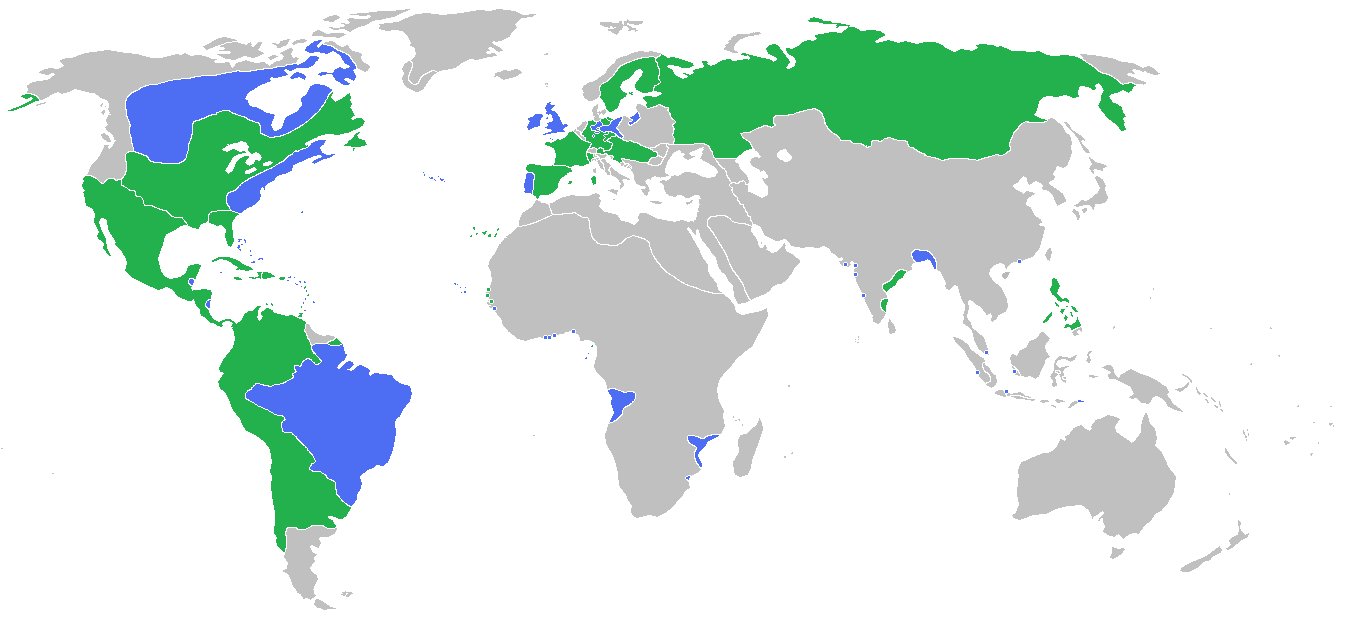 |
| A Map of the Alliance System during the Seven Years War (CC BY 3.0) |
UPDATE: There are some that believe that The Seven Years War cannot be considered a World War because it did not include what has become known as "Total War" where the entire societal apparatus is used to further the war effort. I disagree that this is a requirement for a World War. When I use the term, World War, I am discussion geographic combat, and in that sense, the Seven Years War, was a World War.
The War ended with four treaties:
- The Treaty of Saint Petersburg (1762) - Which ended the Seven Years War between Prussia and Russia. It was a mutual agreement in the simplest terms to end the war with each other, so they could better fight their other enemies.
- The Treaty of Paris (1763) - Which ended the Seven Years war for Great Britain, Prussia, Portugal and their allies against France, Spain, Austria, Russia and their allies.
- The Treaty of Hubertusburg (1763) - Which ended the Seven Years war between Prussia, Austria, and Saxony. It was a side treaty of the Treaty of Paris (1763).
- The Treaty of Hamburg (1762) - Which ended the Seven Years War between Sweden and Prussia.
- Great Britain would annexes (what would be) Canada (Then New France), Begal and Florida.
- France would transfer Louisiana to Spain.
- Northern Armageddon: The Battle of the Plains of Abraham by D. Peter MacLeod (2008)
- The Seven Years War in Europe: 1756-1763 by Franz A.J. Szabo (2000)
- Crucible of War: The Seven Years War and the Fate of Empire in British North America, 1754-1766 by Fred Anderson (2001)
- The Global Seven Years War 1754-1763: Britain and France in a Great Power Contest by D.A. Baugh (2011)
- Plus the many more great history books
Subscribe to:
Posts (Atom)